

« older | Main Largehearted Boy Page | newer »
March 31, 2020
Cai Emmons's Playlist for Her Story Collection "Vanishing"
In the Book Notes series, authors create and discuss a music playlist that relates in some way to their recently published book.
Previous contributors include Jesmyn Ward, Lauren Groff, Bret Easton Ellis, Celeste Ng, T.C. Boyle, Dana Spiotta, Amy Bloom, Aimee Bender, Heidi Julavits, Roxane Gay, and many others.
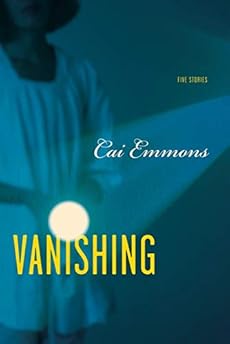
Cai Emmons's short fiction collection Vanishing impressively develops themes of identity.
Kirkus wrote of the book:
"With an ominous air and well-crafted prose, Emmons’ stories are both immersive and challenging."
In her own words, here is Cai Emmons's Book Notes music playlist for her story collection Vanishing:
Vanishing is a collection of five short stories about women who are unsure of their place in the world. Each of these women has had the rug pulled out from under her in some way, forcing her to see that the world is not as she thought it was. Now what should she do?
This playlist was challenging to compile as the stories are focused on identity, particularly female identity in a male world, instead of love and relationships, which is the subject of so many songs. As a result, three of the ten selections here are instrumental tracks.
In “The Deed” the unnamed narrator, an attorney whose husband is away on business, returns home with her twin babies to find a man in the house who claims the house belongs to him. The character works in a law office populated by men who devalue her, so she is primed to cede ground to this intruder. His certainty of ownership confuses and disorients her, leaving her unsure of the truth.
1) “Road to Nowhere” by the Talking Heads
This song encapsulates the mood of “The Deed” perfectly. “Maybe you wonder where you are,” the lyrics say. “I don’t care…they’ll make a fool of you.” Not only do the lyrics speak to the character’s sense of dislocation, but so does the slightly sinister tone of the music.
2) “Vortex” by The Blue Man Group
This instrumental piece employs a range of percussive sounds coming from unconventional instruments. The driving beat continues throughout the piece. Sounds grow and multiply creating a sense of unease and unpredictability. Where will the next intrusion come from? The piece mimics the frame of mind of the story’s protagonist. She is highly anxious and has no idea what to believe or how to ground herself.
“Fat” tells the story of twenty-year-old Tasha who has recently moved from LA to New York to pursue a life as an artist. She is immediately confronted with questions about her talent, and her insecurity is exacerbated by her interactions with a model in her drawing class, Jane, who seems to see the deficiencies of her soul.
3) “Wide Open Spaces by The Dixie Chicks
I think of this song as an anthem for all young women leaving home and seeking the freedom offered by “wide open spaces.” Tasha, like so many who have gone before, is seeking a dream and a life of her own, but as the song says, “What it holds for her she hasn’t guessed yet/ She needs new faces/ She knows the highest stakes.” In Tasha’s case she is quickly surprised to discover how much she has to learn.
4) “Hold On” sung by Brittany Howard of the Alabama Shakes
A song of great musical and lyric power, the song narrates Howard’s dialogue with herself. She is insecure and impatient to prevail, much like Tasha. “I don’t know where I’m gonna go/ Don’t know what I’m gonna do/ Hey you got to wait/ But I don’t wanna wait…I got so much to do/ I ain’t got much time/ Come on girl! Yeah!/ You got to get back up.” The instruction she gives herself is: Hold on and you will survive. Listening to the song in the context of the story “Fat” I hear the influential character Jane telling Tasha the same thing: Hold on and you will be fine.
“Vanishing,” the title story of the collection, is about Marty, a woman in her fifties, recently divorced. She goes to visit her oldest friend Betsy, with whom she shares years of history and memories. But Betsy is now in the grips of early onset dementia and remembers Marty only intermittently. The story explores what happens when people who share important parts of our past disappear from our lives (in Marty’s case, both her husband and her friend). There is terrible sadness for Marty, but also an unexpected connection with her disappearing friend.
5) “And She Was” by The Talking Heads
This song was written about a woman tripping and having the sense of levitating above the world. It sounds to me as if it might describe, in part, what it feels like to succumb to dementia, the feeling of being at some remove from the rest of the world. “The world was moving she was floating above it and she was/ She was drifting through the backyard and she was taking off her dress… Moving into the universe she’s/ drifting this way and that.”
6) “Blue Bayou” performed by Linda Rondstadt
This poignant song of longing speaks to the loss of a person, a lover presumably, but it speaks even more powerfully to the loss of a place, a place where the singer was once happy. The song does what we all frequently do: mythologize past happiness. Martha and Betsy, the two main characters in “Vanishing” would both give anything to return to their shared past, the time before the world damaged them.
“Redhead” tells the story of a recent college graduate floundering in her efforts to put together a life in New York City. Morna can’t find love or work, and she disdains the people she knows who are thriving. When the wife of her former boyfriend dies, Morna becomes entangled in a deceptive relationship with the dead woman’s heartbroken mother.
7) “Everybody Here Hates You” by Courtney Barnett
Courtney Barnett has, like Morna, an idiosyncratic and slightly snarky view of the world. The speaker in this song is addressing a departed lover and, while Morna’s main problem is not a breakup, she shares in common with the singer a feeling of alienation and impotence. “I feel stupid, I feel useless, I feel insane,” Barnett sings. Later she observes, almost gleefully: “Everybody hurts, everybody breaks and everybody fades.” The song’s repetitive rhythm and melody combine to create an overriding and inescapable feeling of depression.
Talmadge, the protagonist of “Her Boys” manages a magazine office where all her employees are young men trying to find themselves. As their leader and queen, she cheers them on, thinking of herself as Wendy with her troop of Lost Boys. But she cannot insulate herself from the wounding that comes each time one of them departs for bigger and better things, and she has to face the fact that the job and she are, to them, nothing but a transitional way station. Her pain is that of the person who is unseen.
8) “Cruel” by St. Vincent
The singer here has been treated by her family in a casually cruel way, precisely the way Talmadge sees her boys as treating her. “They took you and they left you/ How could they be casually cruel…You were the one waving flares in the air so they could see you…And they were a laughter blowing past ya, blowing fastly so they can’t see ya.” The song is eerie in the way it juxtaposes a soaring, almost romantic melody with lyrics that are searing.
9) “A Portrait of Tracy” by Jaco Pastorius
This dreamy instrumental by bassist Jaco Pastorius evokes the wistful interior space where Talmadge escapes to when she comes to understand her insignificant place in the lives of those for whom she thought she loomed large.
10) As a concluding track I have chosen “High Done No Why To” composed by William Brittelle and performed by Roomful of Teeth, an octet of four women and four men. The group was established to “mine the expressive potential of the human voice,” and their pieces cavort through many states of human emotion without using words, or using words that in combination are nonsensical. “High Done No Why To” includes staccato vocalizations, operatic soaring, growling and panting, among other techniques, to capture the cacophony and variety of human life. It is this very variety and cacophony that the characters in Vanishing are trying to navigate.
Cai Emmons is the author of the novels His Mother's Son (which won an Oregon Book Award), The Stylist, and her newest, Weather Woman (fall 2018), about a meteorologist who discovers she has the power to change the weather. Emmons was formerly a playwright and screenwriter, and her short work has appeared in such publications as TriQuarterly, Narrative, and Arts and Culture, among others. She has taught filmmaking at the University of Southern California and Orange Coast College, and creative writing and screenwriting at the University of Oregon.
also at Largehearted Boy:
Support the Largehearted Boy website
Book Notes (2015 - ) (authors create music playlists for their book)
Book Notes (2012 - 2014) (authors create music playlists for their book)
Book Notes (2005 - 2011) (authors create music playlists for their book)
my 11 favorite Book Notes playlist essays
Antiheroines (interviews with up and coming female comics artists)
Atomic Books Comics Preview (weekly comics highlights)
Flash Dancers (authors pair original flash fiction with a song
guest book reviews
Librairie Drawn & Quarterly Books of the Week (recommended new books, magazines, and comics)
musician/author interviews
Note Books (musicians discuss literature)
Short Cuts (writers pair a song with their short story or essay)
Shorties (daily music, literature, and pop culture links)
Soundtracked (composers and directors discuss their film's soundtracks)
weekly music release lists


