


« older | Main Largehearted Boy Page | newer »
July 23, 2020
Susan M. Gaines' Playlist for Her Novel "Accidentals"
In the Book Notes series, authors create and discuss a music playlist that relates in some way to their recently published book.
Previous contributors include Jesmyn Ward, Lauren Groff, Bret Easton Ellis, Celeste Ng, T.C. Boyle, Dana Spiotta, Amy Bloom, Aimee Bender, Roxane Gay, and many others.
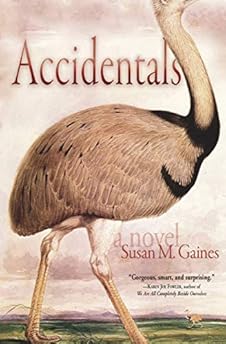
Political and personal, Susan Gaines' novel Accidentals is a profound book that brims with Uruguayan life, science, and birds.
Publishers Weekly wrote of the book:
"Gaines' melding of sensual landscapes with ruminations on political history and environmental devastation will be a treat for conservationists, and her critique of globalization and portrayal of sibling rivalry are particularly well rendered. Barbara Kingsolver fans will want to take a look."
In her own words, here is Susan M. Gaines' Book Notes music playlist for her novel Accidentals:
As I select the music for this playlist, I’m caught in a maelstrom of nostalgia, grief, sadness, and joy—much like the returning emigrant Uruguayans in Accidentals, though I didn’t grow up there. Nostalgia, because these rhythms and melodies evoke times and places and friends who are now beyond reach. Grief, because the world—most notably my own native land—has only pedaled backwards since these hopeful Latin American protest songs were written in the 1960s and seventies. Sadness, because the love songs conjure the ghosts of lost lovers. And joy at the sheer exuberance and inventiveness of Uruguay’s blend of tango, milonga, candombe, murga, jazz, and rock.
Accidentals is the story of a young Californian who accompanies his mother back to her native Uruguay, where he falls in love, discovers a new species of bird—and is forced to confront both the environmental cataclysm of his future, and the dark legacy of his family’s past. My playlist includes songs by Uruguayan musicians who were active from the 1960s through the mid-2000s. This is the music of Gabriel’s mother’s and uncles’ youth—which I myself listened to with my friend Sofia in California in the 1980s, decades before I imagined writing Accidentals—and it’s the music I discovered when I lived in Uruguay in the 2000s, which then accompanied me halfway around the world to Germany, where I found myself living when I finally finished this book so many years after beginning it.
A desalambrar
Daniel Viglietti
One of the most iconic protest songs of South America throughout the 1960s and seventies, with its dreams of a world without fences, where the land and its bounty is shared by those who work it—the sort of idealism that infected Gabriel’s parents’ generation, but which he cannot fathom, as a young man in 1999. Daniel Viglietti was among the founders of the Uruguayan musical movement that came to be known as “canto popular.”
Lyrics
A la ciudad de Montevideo
Daniel Amaro, based on a poem by Carlos Maggi (1976)
A tango full of yearning and nostalgia for a city that Gabriel knows mostly from his mother, who left Montevideo when she was eighteen. Here, he is walking home from a pre-election rally in 1999 with his newly repatriated, somewhat inebriated Tio Rubén, who sings,
“‘Naciste en Montevideo, junto a un río como mar, no busques lugar más bello, porque no lo encontrará . . .’
Prettier places I knew in plenty, but strolling along the Rambla in the dreamy light of a half moon, with the beach trash invisible in the penumbra and the wall of high-rise apartments blending into the night sky, it wasn’t hard to envision this glorious city of the past—which, from the smiles my singing uncle drew, seemed to live on in the mind’s eye of some good measure of the population.”
Recordándote
Alfredo Zitarrosa
Accidentals is both a love story and a family saga about emigrants and exiles, and this beautiful zamba from Zitarrosa captures both. Zitarrosa was another icon of Uruguayan popular music, rejuvenating and adapting many of the traditional rhythms of the Rio de la Plata.
Este es mi pueblo
Los Olimareños, written by Carlos Puebla
A song about returning to a country in ruins, written by the Cuban Carlos Puebla in the fifties, and sung by Los Olimareños—whose music was banned by the Uruguayan dictatorship—at a packed homecoming concert when they returned from exile in 1984. It breaks my heart now, as I listen to it in 2020, after returning to the US where decades of neoliberal rule, four years of government dysfunction, and a democracy in ruins are apparent in every facet of life.
Botija para mi pais
Ruben Rada (el Negro Rada)
And now to cheer things up we need some candombe, from the master himself. The rhythms of candombe bring me back to my friend Pepe’s Montevideo printing company, where I wrote some of the first fragments of Accidentals. The imprenta was in a cavernous old factory building in Barrio Sur, and for a few months in those cash-strapped years I lived on a little platform in the corner, suspended above the printing presses, high on solvent fumes. I moved out as soon as I could, but the imprenta was along the route of the desfile de llamadas, so at the beginning of Carnaval every year, we would gathered there with Pepe’s family and friends, hanging out the windows to watch the thousands of candombe drummers and dancers parade down the street.
Dedos
Rubén Rada with the band Totem
Rada is one of the most inventive, diverse, and cosmopolitan musicians on this list, with work spanning the full spectrum of popular music, from his signature candombes, murga, milonga to jazz and rock, and every possible mix thereof. I could happily have filled this whole playlist with his songs, but “Dedos” will have to suffice to give a sense some of his other sounds. I’m dedicating it to the mothers in Accidentals, Lili and Eva, Elsa, and Abuela.
Milonga de los ojos dorados
Alfredo Zitarrosa
There is more than one love story in Accidentals. This beautiful milonga is for Rubén.
Canto de barrio y barrio
Falta y Resto
Murga is an idiosyncratic form of musical theater that relies on a traditionally male (though that has changed in the last decade) chorus, incredible percussionists, absurd costumes, and lyrics that usually tell some sort of story and have you laughing, crying, and scratching your head at the same time. It’s one of the signature musical forms of Uruguay’s Carnaval, and one really has to see it in that context, but I couldn’t find any good videos so here is one of Falta y Resto performing in the TV studio, just to give an idea of the show.
Like most of the musicians on this list, Jaime Roos has been around since the sixties, and like Ruben Rada he continued to compose and experiment for decades. But he remains one of Uruguay’s finest composers of murga. And I love this one.
El beso que te di
Los Olimareños
I can’t leave without this love song from Los Olimarenos. It’s from their first album--from Lili’s generation--so I’ll make it her closing gift to her son and Alejandra.
Susan M. Gaines is the author of the novel Carbon Dreams and of the science narrative, Echoes of Life: What Fossil Molecules Reveal About Earth History. Her short stories have appeared in numerous literary journals and been selected for the Best of the West anthology and nominated for the Pushcart Prize. Gaines's fiction is informed by a youth spent hiking and birding California's mountains and coastline, and by her education in chemistry and oceanography. She is the recipient of an Art in Science Fellowship at the Hanse Institute for Advanced Study, as well as the 2018 Suffrage Science Award. Currently at work on another novel, Gaines divides her time between her native California, Uruguay, and Germany, where she co–directs the Fiction Meets Science research and fellowship program
If you appreciate the work that goes into Largehearted Boy, please consider making a donation.


