

« older | Main Largehearted Boy Page | newer »
August 24, 2020
Kendra Atleework's Playlist for Her Memoir "Miracle Country"
In the Book Notes series, authors create and discuss a music playlist that relates in some way to their recently published book.
Previous contributors include Jesmyn Ward, Lauren Groff, Bret Easton Ellis, Celeste Ng, T.C. Boyle, Dana Spiotta, Amy Bloom, Aimee Bender, Roxane Gay, and many others.
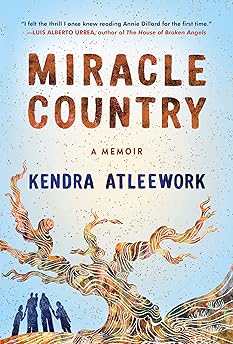
Kendra Atleework's memoir Miracle Country is as much about her own history as it is an ode to the California's high desert Eastern Sierra Nevada, a truly remarkable book.
The San Francisco Chronicle wrote of the book:
"Truly something special and refreshing. Kendra Atleework’s powerful debut is the rare trifecta that seamlessly blends personal narrative with historical nonfiction and highly charged, activist-style rhetoric with rarely a misstep or heavy hand . . . Whether you’re in it for the emotional roller coaster or want an armchair view of an area of California not on your radar, Miracle Country works on multiple levels. It reminds us to hold our loved ones close, conserve our resources, treat the land as sacred and stop putting our collective heads in the sand when it comes to climate change."
In her own words, here is Kendra Atleework's Book Notes music playlist for her memoir Miracle Country:
I come from a remote desert valley in California, at the eastern base of the Sierra Nevada mountains, a place often visited by drought and wildfire, on the frontlines of climate change. Mine is the kind of town you might recognize from the lyrics of a country song. Here, my parents taught us to love our home despite the fickle economy and harsh climate. But after my mom died when I was sixteen, my home felt empty, and I fled for a decade. I wanted nothing more than to get out, to move far away, to write for a music magazine and live in a big city. I pulled it off for a while—I moved to Los Angeles and worked at an underground radio station and played in bands and ran punk shows. But I grew up on sixties and seventies folk music (thanks to my mom) and country western (thanks to KIBS, the radio station in my small town). All the time I was far from home, a current of music that reminded me of what I’d left behind ran through my head. After years of avoiding the place I came from, I realized I needed to come to terms with the past—with California’s troubled history and with my own difficult memories—and move back. Nowadays I live in my dusty little hometown of Bishop, California, and I’m not going anywhere. Miracle Country, and these songs, tell the story of family and home, of flight and return.
“Here in California” by Kate Wolf
I’m a little kid, and my mom and I go for a walk under the stars, in the middle of nowhere, halfway up a mountain in summer. Mom is a grown-up child of the seventies; I like catching lizards in the brush after school. There are things in this world from which she cannot protect me, and she knows. Still, tonight, we are alone together. We toss our clothes and walk up the mountainside in only our hiking boots, night air brushing our skin. This is the opening page of Miracle Country. Later, I contend with my mom’s death and the history of my home, a place that’s been stolen many times over from those who have loved it. There really is no gold in California, as Kate Wolf tells us, and the hills go brown in summer and black after fire, but still this is the only place in the world I can live.
“Fast Car” by Tracy Chapman
Summer again, a year after Mom’s death. I’m seventeen and I ride in the passenger seat beside my friend Elizabeth as she steers us through the desert after dark. We’ve just finished the night shift at the greasy spoon where we shlep burgers. We know there’s a world beyond our four-stoplight town which has come to feel empty and we want to run away together. In this dry valley we can smell the river. Los Angeles owns this river, and not far from here the water flows into a giant metal tube and travels to the city 230 miles south, as it has for one hundred years. We mourn its loss without understanding. We park on the bank, leave the car doors open, let the music play while we float on our backs in the water.
“Love Will Tear Us Apart” by José González
I leave my town, leave Elizabeth in the old cafe. I go to college in the city: Los Angeles, that prowling predator that swallows up the teenagers from my home when we stray too far. I live in a dorm room and look out at the silhouettes of palm trees, and home is an empty place, suddenly ugly, the den of loss. In the neon city, I play bass in a post-hardcore band and hang out with punks and listen to this song (a Joy Division cover) and Fugazi and Jawbreaker and walk around in the rare Los Angeles rain and do my best to never go home.
“Sister” by Angel Olsen
I’m nineteen, subletting a bedroom in an apartment in Koreatown, Los Angeles. My sister lives four miles away in a studio apartment with a boyfriend who burns holes in the carpet with his bong. Her neighborhood ranks high for violent crime but she grows jalapeños in her small patch of dirt and the local teenagers chat with her on her stoop in the mornings. She’s working as a model and a hostess in a restaurant in Beverly Hills and we run together on the treadmills in my building basement and buy matching sandals at the flea market and eat burritos in the pink Los Angeles twilight, and through the haze of weed smoke I see my sister for the first time in years and I see her pain.
“One More Hour” by Sleater-Kinney
My brother is a teenager and he’s lost to me, living in lockdown facilities for juvenile delinquents in the deserts of Utah and Nevada. When he escapes from one, running barefoot until the guards catch him, he gets sent to another. I don’t visit him and I don’t always tell new acquaintances I have a brother, because his transition from a kid I loved into an angry person who scares me is not something I want to talk about. I play this song on my college radio show and think about the way he’s learned to shut the light off in his eyes and I miss him.
“Your Hand in Mine” by Explosions in the Sky
Summer of 2014, deep in the heart of the California drought, the worst in over one thousand years. I’ve moved far from California and all its dryness. I’m living in Minnesota surrounded by water, but still I’m pulled home. I fly back and take a road trip through the California towns hit hardest by the drought. I see empty reservoirs, fallowed fields in the Central Valley where food for the whole country usually grows, the aftermath of wildfire, and small towns lived in by farm workers who have to bathe in buckets after wells run dry.
I visit one reservoir that’s still full. It’s called Hetch Hetchy, and it was once a valley in Yosemite, on the western flank of the Sierra Nevada, across the mountains from my home. Hetch Hetchy Valley was dammed in 1926 and is now submerged. I listen to this song as I drive down to the reservoir, winding and winding toward the dark pool, and I have tears in my eyes as I think of the beauty of what has gone—as I see the strange beauty of what has come to take its place.
“Peach Plum Pear” by Joanna Newsom
I’m on a hiking trail in northern Minnesota, Lake Superior big as the sea and turquoise at my side. The stillness here and the darkness at night feels more familiar to me than Minneapolis ever will, even after five winters in that city. In the wilderness of northern Minnesota, I walk alone for miles and music plays in my head. I first heard Joanna Newsom when I was a sixteen-year-old goth kid in love with The Cure. My friend Elizabeth showed me this song and I hated it and she said listen again, I think you’ll like it, and thus began my obsession with this harpist who sings about her love for her own little California town across the mountains from my own. She sings about kingfishers and autumn and jackrabbits and the way the moonlight filters down milky in summer, and her love for it all makes me brave enough to face my homesickness.
“Night Rider’s Lament” by Don Edwards
I’ve flown home from Minnesota for a visit. My dad, an empty nester lonely on the mountainside, is expanding his social horizons by doing community theater. He plays the old cowboy Virgil in Bus Stop and learns a few chords on the guitar. While I’m home I grade student papers in front of the fire while I listen to him practice his solo. Pop strums and sings in his thin falsetto. This song is about choosing a difficult life in a place you love, and when I hear him sing it I think of his decision to move to our valley as a young man, to live in a burned-out building in the desert and pump gas at the little county airport, all so he can be between these mountains.
“I'm Gonna Be a Country Girl Again” by Buffy Sainte-Marie
I pass winter nights in Minneapolis sitting at a desk bright with candles and reading the history of the place I left behind. I live in a city of millions but I’ve developed a habit of listening to country songs about returning, going home, walking backward, like this song by Buffy Sainte-Marie, a Cree musician whose 1968 album of the same name got her blacklisted. I’m reading about the generations of people who have called my desert valley home, while this song plays and snow falls out the window, lit by the streetlights. And it’s beautiful, but I know I belong in a place with a huge dry sky.
“Both Sides Now” by Judy Collins
I’m a kid again, and my mom is singing. She’s singing a song about knowing less the older you get, about accepting your inability to understand. And I don’t know it yet, that this is life: realizing you don’t have the answers, and neither does anybody else, and it’s the mystery that’s the point of it all. I sense something in my mom’s voice, in the lyrics. Do I picture the moment my dad and sister and I will summit the mountain overlooking the place we once lived together, years after she is gone? Do I know, somehow, that I will lose her, that I’ll write a book, maybe more than one, trying to reach her, trying to know? I may never get there, but at least I have the memory of her singing this song.
Kendra Atleework is the recipient of the Ellen Meloy Desert Writers Award and was selected for The Best American Essays, edited by Ariel Levy. She received her MFA in creative writing from the University of Minnesota and now lives in her hometown of Bishop, California.
If you appreciate the work that goes into Largehearted Boy, please consider making a donation.


