

« older | Main Largehearted Boy Page | newer »
February 22, 2021
Elizabeth Knox's Playlist for Her Novel "The Absolute Book"
In the Book Notes series, authors create and discuss a music playlist that relates in some way to their recently published book.
Previous contributors include Jesmyn Ward, Lauren Groff, Bret Easton Ellis, Celeste Ng, T.C. Boyle, Dana Spiotta, Amy Bloom, Aimee Bender, Roxane Gay, and many others.
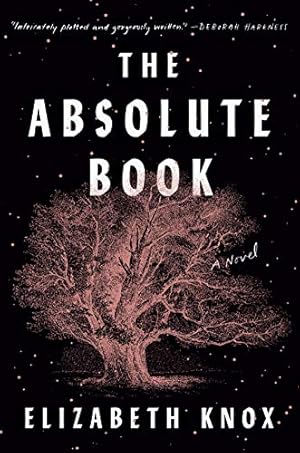
Elizabeth Knox's The Absolute Book is an epic fantasy novel grounded in mythology and unfolded with spellbinding storytelling.
Booklist wrote of the book:
"Knox’s restrained, poetic writing works well with this ever-spiraling, mind-blowing optical illusion of a novel, which marries myths and lore from Celtic, Norse, and Judeo-Christian traditions with a variety of literary references. Weird and enigmatic...this grand ode to Story itself is one that begs for a reread."
In her words, here is Elizabeth Knox's Book Notes music playlist for her novel The Absolute Book:
I set out to write this and got distracted by Appalachian folksinger Jean Ritchie on Youtube. At the dinner table I asked my son whether he remembered me singing to him all those old English ballads like Matty Groves and Mary Hamilton. Yes he did. ‘You'd always make yourself cry.’ Which is why I should never be in charge of the music. Fortunately for me someone else has always been in charge of the stereo – my father, then my younger sister, then my husband – people more decisive and enthusiastic about what they listen to. Music always arrives for me like birdsong, with only an occasional objectionable bird. I don’t have to do any thinking, and I can always ask, ‘What is this?’ and hear why my husband likes it, where it comes from, how it came to be. But plenty of the music takes, attaches itself to me, those songs we listen to in the evening or on road trips.
All these pieces are tangled up somehow with The Absolute Book – a playlist that grew with the novel, the novel starting small, like one of the epiphyte forms of Northern Rata, up in the sunlit branches, slowly clambering down its host tree to take root and become another tree.
Schubert's Winterreise (Florian Boesch and Malcolm Martineau).
All of it, but particularly the last five songs – ‘the signpost’ to ‘the hurdy-gurdy man’. From ‘what foolish longing drives me into the wilderness’ to that final stately, limping dance, where the music seems to be walking backwards with sliding steps out of the room. That last song seems very different than the rest, and I guess that difference and its air of something patiently proposed in a new tone, but in the same terms that have shaped the whole, is something that gave me encouragement about my ending. ‘Barefoot on the ice. He sways back and forth… And he lets it go on, everything, just as it will.’
Maurice Ravel, L’Enfant Et Les Sortileges (Sir Simon Rattle and the Berliner Philharmoniker) Part II.
This little opera is a sort of musical of Where the Wild Things Are. A child is angry at his mother, has a tantrum, escapes into the garden – at night – and there is everything (just as it will), amorous cats, the rain, frogs, a squirrel the child attempts to trap. The child is a threat and a disturbance, but then he hurts himself and all the animals coordinate their voices till they are calling for his mother. It's lovely –a world full of creatures with potential for tenderness towards one another. It has always reminded me of the forest spirits in Hayao Miyazaki’s My Neighbour Totoro – gardens full of animals, and forests full of spirits, and the humans who can see them and aren’t separate from them.
Stardust. Hoagy Carmichael
Other people sing this song but I prefer the composer's breezy unemphatic version. He knows what he means. This is your basic love song where someone speaks to someone else who is no longer there. It’s nostalgic, regretful, but more rueful than tragic—this guy is long past weeping into his whiskey. The words and music are both like speech, the singer seems to ramble, has a few flourishes. Then the song does what I most love it for, it sallies forth in little gasping gaps, then climbs up a short stair of glass and starlight into a turret of a memory – out of nowhere – ‘beside a garden wall, when stars are bright, you are in my arms’, rushed and panting, then sure and shining ‘the Nightingale tells his fairy tale, a paradise where roses bloom’. The singer believes and doesn't believe it, he knows he's being told a story, ‘I dream in vain’. He knows it, but the feeling is real in as much as ‘in my heart it will remain’.
It's a song that has a very light touch with its deep feelings, is almost throwaway, but carries its little capsule of transcendence.
On a more bracing note, REM, ‘It's The End Of The World As We Know It’.
This is a song I've listened to for years to cheer myself up, and which has remained cheering, no matter that now seems to have prophecies in it: ‘team by team, reporters baffled, trumped, tethered, cropped…a tournament, a tournament, a tournament of lies.’
The Absolute Book’s continuous timeline of seven months between April, when Taryn collapses at her best friend's wedding, and October when she is at a very strange summit meeting in an 18th-century marble folly, on an island, on the grounds of her family's former home, is mapped on 2017, though with very few clues, and possibly only to give myself a ‘now’ for the book. I think of ‘It's The End Of The World As We Know It’ as both Jacob’s and the Muleskinner’s song, two potentially violent men with a degree of mastery over either the social or natural world. Either one of them might say, as the song does, ‘offer me solutions, offer me alternatives, and I decline.’ One man can imagine no solution that isn’t engineered by him, and the other in the end gives up everything he knows and understands and has power over for an ‘alternative’ and is happy to live as either cynic or believer so long as he can continue to exercise his appetite for both positions.
Phil Collins, ‘In the Air Tonight’.
I’ve loved this since it came out – and had to pretend not to because I was only listening to punk rock and German electronica. There’s that YouTube video of the two post-millennials listening to it for the first time – making expressions of faintly impressed concession to what it's doing, till the break when it blazes out with all its controlled fury, and more energy of joyous ill-will than just about any other song. At which point the young men get pretty bloody excited.
The Absolute Book has an accomplished revenge at its heart. The revenge starts off looking like backstory. As if all there is left of it is just sick guilt. Then it comes to life again – the revenge’s loose ends knotting themselves to make a noose, and the protagonist Taryn is suddenly in deadly danger.
Phil Collin’s great rock anthem remains a live wire for me.
Emmylou Harris, ‘Boulder to Birmingham’
It's this song’s combination of plaintive emotional exhaustion and grandeur that has it forever running in my head. Emmylou Harris wrote it after Gram Parsons died. It's a song of love and loss by a friend and collaborator.
The ferocity of Taryn's feelings for her lost sister are central to The Absolute Book as is the growing passionate friendship she forms with the mysterious Shift. There's nothing in ‘Boulder to Birmingham’ to suggest that its force of feeling isn't about romantic love – except maybe the purity of its towering loneliness. The way Harris doesn’t lay any claims, just shows you where she is. ‘The last time I felt like this. I was in the wilderness and the canyon was on fire. And I stood on the mountain, in the night, and I watched it burn, I watched it burn, I watched it burn.’
‘Andy’, Songs From The Front Lawn, by Don McGlashan and Harry Sinclair
This song is just one of the ludicrously huge number of great songs on this great album. Written by McGlashan in memory of his dead brother, this song was never far from my mind when I was thinking about the constancy of the presence of Taryn's dead sister Beatrice. I haven't had to imagine losing a sibling. (There is an ambivalent sentence that I'll just leave there).
It starts with drones and bells, like Tibetan temple music, then falls into a tramp and swaying like a sea shanty, or carnival music. The lyrics begin with a proposed walk, with a one-sided conversation, with patience, with a plea, ‘Andy, don't keep your distance from me’. It's sparse and measured, then it thickens—the music—and hastens—the lyrics, and the brother who is speaking is full of things to share, not the least of which is his indignation at the difficulty of describing the changes in their home town. It all comes out a pressured rush of rage and grief. ‘Can you believe this place? Well can you? They’re making money out of money, they’re making buildings out of glass…’ The song opens with the living brother speaking to the dead one as if he’s still alive, goes on with the impossibility of catching up the dead—both catching them up, and catching up with them—then comes around to acknowledging the distance between them and admitting to all the wishes of grief. It's a miracle of a song and, like many of the songs on the album, it’s a story, an enactment, a whole drama.
Shirley Collins, Heart’s Ease, ‘Locked in Ice’
While I was re-editing The Absolute Book for northern hemisphere publication, I became entranced by Heart’s Ease, a new album by 85-year-old Sussex folksinger Shirley Collins, and especially the song ‘Locked in Ice’, about ‘a little ghost ship on the Beaufort Sea’— ‘Locked in ice, half a hundred years, Where the ice goes, I go, I go, I go.’
The song is in the voice of the ship, pleased with its usefulness, its part in human commerce; then left by its crew in the ice floes. What moves me most is the song’s animism. The ship has a soul, and a self once its abandoned. That, and the way that Collin’s voice is sometimes near and sometimes far, like a lonely singer heard by someone standing on the shore who can’t see where the music is coming from.
I really have learned so much from music about how to write fiction. The arias of dramatic utterance. But I definitely shouldn't be in charge of the stereo. And it's better if on a daily basis I forget my Spotify, because I'm far too fond of those songs that leave you standing on the ice in bare feet.
Elizabeth Knox is the author of seventeen books, including the novels The Vintner's Luck, Dreamhunter, and Dreamquake, which received awards from the ALA, CCBC, Booklist, and The New York Public Library. An Arts Foundation Laureate, an Officer of the New Zealand Order of Merit, and the recipient of the Prime Minister's Award for Fiction, she lives with her husband and son in Wellington, New Zealand, where she teaches a course on world building at Victoria University.
If you appreciate the work that goes into Largehearted Boy, please consider making a donation.


