

« older | Main Largehearted Boy Page | newer »
March 31, 2021
Aaron Poochigian's Playlist for His Translation of "Aristophanes: Four Plays"
In the Book Notes series, authors create and discuss a music playlist that relates in some way to their recently published book.
Previous contributors include Jesmyn Ward, Lauren Groff, Bret Easton Ellis, Celeste Ng, T.C. Boyle, Dana Spiotta, Amy Bloom, Aimee Bender, Roxane Gay, and many others.
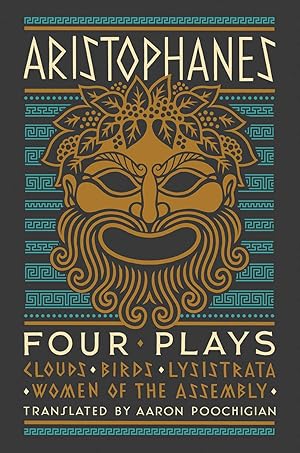
Aaron Poochigian's translation of Aristophanes: Four Plays expresses the timelessness, lyricism, and wit of the Greek poet.
Emily Wilson wrote of the book:
"Aristophanes was a funny, often obscene, social commentator, and he was also a brilliantly fluent, wide-ranging poet, whose lyric rhythms were recited and sung to music, with dancing. It’s very rare for modern translators to convey his poetic virtuosity or make any attempt to bring his meters to life. But Aaron Poochigan has achieved this feat, crafting polymetric translations that convey the whole range of Aristophanes’s larger-than-life characters and provocative, alternative reality scenarios. This new Aristophanes is zany, sharp, inventive, vivacious, and surprisingly relevant for our times."
In his words, here is Aaron Poochigian's Book Notes music playlist for his translation of Aristophanes: Four Plays:
Intro:
“The Origin of Love,” Hedwig and the Angry Inch
What better introduction to plays in which a man puts on a slip and women’s shoes and women don beards and take over the government than this ballad from the musical Hedwig and the Angry Inch? The lyrics bring us back to a time before the rigid division of human sexuality into two genders, and the mythopoesis sets us up for the fantastical. Indeed, within the pages of this book, anything can happen.
Clouds:
“We Don’t Need No Education,” Pink Floyd
We don't need no education
We don't need no thought control
No dark sarcasm in the classroom
Teachers, leave them kids alone
By the end of play the main character Strepsiades comes around to agreeing with Roger Waters and goes to burn the Thinkery, the bastion of “new” learning, down. As he sees it, sophists and sham intellectuals ruin the young with their amoral education and it would be better if such teachers would “leave them kids alone.”
Birds:
“If You Wanna Be a Bird,” The Holy Modal Rounders
This song, which compares the feeling of getting stoned on weed to metamorphosis into a bird, is the perfect prelude for Aristophanes’ most wacked-out comedy. The main characters, Peisthetaerus and Euelpides, do indeed sprout wings and together create a utopia free of daily annoyances. What a relief, what an escape it is, to “get high” like the birds!
“Eight Miles High,” The Byrds
Then, when you finish this utopian play, to “come down,” I suggest this song by The Byrds. It will ease you back into the humdrum and frustration of life on earth, where one must walk again among the “squares” and “sidewalk scenes.” Only through art can one experience utopia.
Lysistrata:
“War (What is it Good for?),” Edwin Starr
War
I despise
It means destruction to innocent lives
War means tears
To thousands of mothers' eyes
When their sons go out to fight
And lose their lives
I don’t know whether the gruff Mr. Edwin Starr ever read “Lysistrata” but, consciously or not, he is summarizing here the exact sentiment the titular character expresses to the war-hawk Commissioner:
". . .Prick! we have more than twice as much at stake
as you [men] have! First off, we give birth to sons and send them out
to battle in your war.”
“Dame with a Rod,” The Juliana Hatfield Three
Whoa! So much to talk about here! “Rod” in the title is slang for both “gun” and “dick,” and the “heroine” in this song uses her “rod” to inflict the ultimate punishment on a date-rapist. After rough treatment and harsh words from Lysistrata and the women of Greece, the Athenians and Spartans end their protracted war. Like the date-rapist, they “won’t do it again.”
Women of the Assembly:
“Suffragette City,” David Bowie
Yay! Everyone loves David Bowie! In “Women of the Assembly,” the Athenian woman Praxagora and a female gang, because they are not allowed to vote in the Assembly, put on fake beards and men’s boots and become suffragettes in disguise. They radically socialize Athenian democracy, and the anxieties of the men in the play echo contemporary anxieties about Representative Alexandria Ocasio-Cortez and the “squad.”
“Sisters Are Doin’ it For Themselves,” Aretha Franklin
Now there was a time
When they used to say
That behind every great man
There had to be a great woman
But in these times of change
You know that it's no longer true
So we're comin' out of the kitchen
'Cause there's somethin' we forgot to say to you.
These lyrics could just as well belong to a choral ode in the “Women of the Assembly.” What the women “forgot to say” is: You men have been in charge for thousands of years and look at all the damage you have done! It’s our turn! This anthem is a rousing, triumphal conclusion to the playlist.
Aaron Poochigian has published four books of poetry, including a novel-in-verse, Mr. Either/Or, and several translations, including the poetry of Sappho (Stung with Love) and Aristophanes: Four Plays. He lives in New York City.
If you appreciate the work that goes into Largehearted Boy, please consider making a donation.


