

« older | Main Largehearted Boy Page | newer »
April 19, 2021
KT Sparks's Playlist for Her Novel "Four Dead Horses"
In the Book Notes series, authors create and discuss a music playlist that relates in some way to their recently published book.
Previous contributors include Jesmyn Ward, Lauren Groff, Bret Easton Ellis, Celeste Ng, T.C. Boyle, Dana Spiotta, Amy Bloom, Aimee Bender, Roxane Gay, and many others.
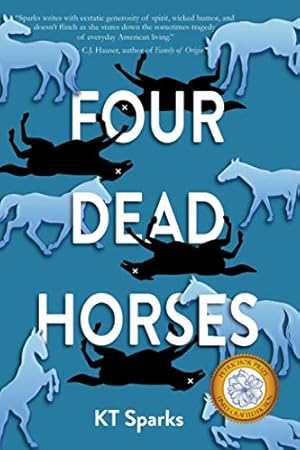
KT Sparks' novel Four Dead Horses is a heartfelt and witty debut, and its protagonist's eccentricity is unforgettable.
Dana Spiotta wrote of the book:
"KT Sparks has written a wild, sharp-edged, wickedly funny debut novel. Her characters are truly vivid and eccentric creations. Sparks is a master of perfectly controlled, fully loaded, turbo-charged sentences that will surprise and delight you."
In her words, here is KT Sparks' Book Notes music playlist for her debut novel Four Dead Horses:
The wannabe hero of my novel Martin Oliphant, grows up in the upper Midwest in the seventies and early eighties—as I did—and thus the soundtrack of his youth was the (now) classic (then “popular”) and hard rock of that era and the (even more) classic sounds of the late sixties-early seventies bands shared by older siblings and the cool stoners a couple of years ahead in school. He would have consumed the music from the transistor radio he got for his 13th birthday, off mix tapes recorded with a cassette player held next to the stereo, through speakers at roller and ice rinks that blasted it out in between warnings against crack-the whip, and in high school gyms at dances deejayed by the kid with the best Panasonic hi-fi speakers—as I did. By 2015-2016, when the second part of Four Dead Horses takes place, Martin might nod knowingly, even appreciatively, at the mention of Nicki Minaj, but what he listens to on his earbuds or hums to himself as he stumbles through his days has changed not at all in the past thirty years. This is the playlist I believe Martin would compile for his own story, past and present, and it’s not far off the one I’ve compiled for my own.
“Pleasant Valley Sunday,” The Monkees
Chances are good that pre-teen Martin spent his Saturday mornings tuned into The Monkees’ TV series, which played on repeat throughout the seventies. Equally likely: that he watched his mother Dottie’s epic social climbing, on full display in the novel’s first chapter, while silently whistling this Carole King-Gerry Goffin iconic reproof of “status-symbol land.”
“The Wreck of the Edmond Fitzgerald,” Gordon Lightfoot
Martin, a socially inept, overly intellectual, horse-hating Michigander, finds the love of his life at 21 in the bronc-riding, barn smart, Western cowgirl Ginger. They bond eventually over a shared passion for cowboy poetry, though their first connection is a mutual admiration of Gordon Lightfoot. Perhaps it’s because his famous ballad so resembles the old English ballads, which also inspired many of the first cowboy poets. Perhaps it’s because the only Michigan landmark Ginger can conjure up at that first meeting is “the big lake they call ‘Gitchee Gumee.’”
“Fire,” Pointer Sisters
Nothing gets Martin’s frisk up like an enthusiastic recitation of the classic cowboy poem, “The Campfire has Gone Out,” but his choice of paramours at such times are never the best. The Pointer Sisters in “Fire” capture exactly the beat and tone of that delicious dichotomy between good decisions and gobsmacking lust (even folk-art enflamed lust).
“Time for Me to Fly,” REO Speedwagon
My favorite scene in the novel is one in which a young Martin, over the course of a raucous and drunken evening in a hometown bar, decides to devote his life to higher callings—like poetry, honor, and true love. “Time for Me to Fly” perfectly captures the over-the-top sentimentality and yearning that he feels—and is probably felt at least once by every twenty-something guy who’s sat in a dark Midwestern bar sipping Schlitz and contemplating his future.
“Cool for Cats,” Squeeze
Squeeze, part of the first wave of New Wave, was popular into the eighties more in the UK than the U.S., but Martin would have listened to them with his fellow undergrads at University of Chicago, whose population of nerds embrace Anglophilia as ardently as they do quantum physics and Plato. Also, the song’s frenetic beat matches the manic pace of Martin’s time at home managing his delusional and dying mother and his lunatic of a father. An added plus is the lyrics’ extended Western metaphor: “And Davy Crockett rides around and says it’s cool for cats…”
“Life During Wartime,” Talking Heads
As Martin’s mother nears death, the cowboy poetry he has leaned on to help guide him through darker and darker days goes silent. Martin is left to face the violence and pain of real life alone. “This ain’t no party, this ain’t no disco, this ain’t no fooling around,” as David Byrne sings.
“Higher Ground,” Stevie Wonder
In the middle of Four Dead Horses, one chapter races through thirty years of Martin’s life. “World keeps on turning.” It may be hard to watch Martin put aside, again and again, his youthful dreams of cowboys, love, and poetry, but though they are unrealized, they are not forgotten, and there’s some hope in that. “Gonna keep on trying ‘til I reach my highest ground.”
“Rocky Mountain High,” John Denver
I know it’s overplayed and a Colorado cliché. But still, it’s a great song, and there could be nothing else running through Martin’s head when he catches his first glimpse of the continental divide in the distance. That he does so from the porch of his odious brother’s Denver foothill’s mega-mansion makes “Rocky Mountain High” even more appropriate. The lyrics include a jab at the developers destroying the Rocky Mountains’ natural habitats to build exactly that sort of place.
“Should I Stay or Should I Go,” The Clash
Throughout the book, Martin struggles with the increasingly high price—in terms of friends, values, and equine lives—that he is asked to pay in order to achieve his goal of reciting with the real cowboy poets in Elko, Nevada. More than once, he laments along with Mick Jones: “If I stay then there’ll be trouble. If I go it will be double.”
“Heroes”, David Bowie
The charm and the curse of most of us brought up in the Midwest is that we dream big but expect little. But there is an optimism that underlies (and redeems) that otherwise fatalistic worldview— the firm belief that every one of us “can be heroes, just for one day.” Martin gets that chance. Whether he takes it or not—you’ll have to buy the book to find out.
KT Sparks is a former speechwriter and policy analyst who worked in the U.S. Senate for 20 years before leaving Washington in 2007 to run a sustainable, organic farm. She is now a writer and farmer living in the Shenandoah Valley of Virginia. Her first book, Four Dead Horses, the story of cowboy poetry and the Midwestern pet mortician who loves it, is out now.
If you appreciate the work that goes into Largehearted Boy, please consider making a donation.


