

« older | Main Largehearted Boy Page | newer »
August 3, 2021
David Hoon Kim's Playlist for His Novel "Paris Is a Party, Paris Is a Ghost"
In the Book Notes series, authors create and discuss a music playlist that relates in some way to their recently published book.
Previous contributors include Jesmyn Ward, Lauren Groff, Bret Easton Ellis, Celeste Ng, T.C. Boyle, Dana Spiotta, Amy Bloom, Aimee Bender, Roxane Gay, and many others.
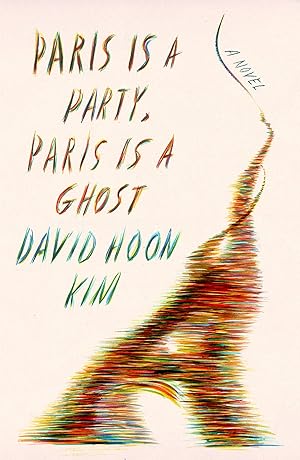
In David Hoon Kim's Paris Is a Party, Paris Is a Ghost beauty and mystery commingle and coalesce into an unforgettable novel.
Kelly Link wrote of the book:
"The kind of book that holds you in a dream as you read it, intricate and frictionless and always marvelous. David Hoon Kim in his deep understanding of the strangeness of human experience and the connective bands between past, present, and future, belongs in the same company as writers like Emily St. John Mandel and Lauren Groff."
In his own words, here is David Hoon Kim's Book Notes music playlist for his novel Paris Is a Party, Paris Is a Ghost:
Paris Is a Party, Paris Is a Ghost tells the story of Henrik Blatand, a Japanese adoptee raised in Denmark who comes to Paris and falls in love with an art student from Japan named Fumiko. The book is divided into three sections: “Fumiko”, “Before Fumiko” and “After Fumiko”. As one might expect, she is a recurring motif in Henrik’s trajectory, even though, by the end of the book’s first sentence, she has already locked herself in her room and disappeared (in French, “disappear”, in addition to its usual meaning, can also mean “cease, permanently, to be visible”, ie. death).
The playlist that follows is made up of songs that are explicitly alluded to in the book, songs that I remember listening to while writing the book, and/or songs that seem to me thematically relevant.
Part 1. Fumiko
Takagi Masakatsu - Flat Echo
This might be the song (from his seminal album Rehome) that started it all. I played it repeatedly, obsessively, while writing “Sweetheart Sorrow” - which became the first chapter of Paris Is a Party - in my apartment in Iowa City during the winter of 2006. It’s a haunting and wistful melody that could be Fumiko’s theme song, as if it were written specially for her (“There is a road in front of me / it is so long and flat / all I can hear is echoes of my shoes...”). Hearing it now takes me back to my years in the north of France when I was listening to a lot of electronica, mostly ambient and drum & bass - Aphex Twin and Talvin Singh, but also lesser-known artists like Vitamin Man and Ben Neill - alone in my residence hall room or waiting for the métro on a deserted platform.
Daniel Balavoine - Tous les cris les SOS
“Tous les cris les SOS” is about loneliness - among other things -, as expressed by the metaphor, in the song, of an empty bottle being thrown to the sea (and which is returned by the waves, again and again). The idea of sending out a message to someone who is no longer “there”, who will never receive it, seems to me another form of folly, though that doesn’t stop my protagonist as he wanders through Paris looking for traces of Fumiko.
Keren Ann - La disparition
Possibly Fumiko’s other theme song, though it could just as well be the song for the entire book:
C’est le seul vide que je comblerai peut-être
Le seul horizon que je vois par la fenêtre
Le seul sommeil qui pourra me faire renaître
Je t’embrasserai juste avant de disparaître
[it’s the only void that I can perhaps fill
the only horizon that I see through the pane
the only sleep that will let me be reborn
I’ll give you a kiss just before I disappear]
Part 2. Before Fumiko
Jean-Jacques Goldman - Là-bas
An old favorite of mine, “Là-bas” is one of the first French songs I heard, and though I wasn’t a child in France in the eighties when this song first came out, hearing it takes me back to my early days of linguistic discovery in French - a childhood of sorts, perhaps. I listened to “Là-bas” again - about someone wanting to leave the confines of his native country - during much of the writing of the book’s “Before Fumiko” section, the “Paris Is a Party” suite of vignettes, which tells the story of Henrik’s departure from Denmark and of his first year in Paris.
Manu Chao - Bongo Bong
I remember buying Manu Chao’s first solo album Clandestino (along with Rhythm & Sound’s Showcase and the soundtrack to Jean-Pierre Limosin’s Tokyo Eyes) at a record shop in Rennes during the winter of 1998. At the time, everyone seemed to be listening to Manu Chao. “The Bridge” - a chapter from “Paris Is a Party...” - recounts Henrik’s “frenemy”-ship with a floormate of his residency hall, a Swede named Joakim, and the passive-aggressive, linguistico-national rivalry that ensues between them. It is during one of their many conversations/arguments, as they sit facing each other at the communal kitchen table during one of the weekend floor parties, that the Manu Chao song is heard playing in the background (“Mama was queen of the mambo / Papa was king of the Congo...”) - a sort of cherry of ridiculousness on top of the cake.
Luna - Bonnie and Clyde (with Laetitia Sadier of Stereolab)
The “Empire of Death” chapter opens with a party hosted by Sang-hoon, one of the Korean students Henrik gets to know in Paris. At one point, Sang-hoon tells Guang-ho, both of whom work as guides for Korean tourists, to lower the volume after the latter puts on Serge Gainsbourg’s “Bonnie and Clyde”, which is a reference to a similar moment in Olivier Assayas’ film Irma Vep, where someone puts on Luna’s cover of Gainsbourg’s song and someone else tells him/her to turn the sound down.
Jean-Jacques Goldman - Ensemble
Staying with “Empire of Death”, there is a scene in the catacombs, which Henrik visits with Ji-hae, one of the Korean girls encountered at Sang-hoon’s party, that was inspired by a line - “Je ne me souviens que d’un mur immense” [all I recall is an enormous wall] - from another J-J Goldman song. In the catacombs, Henrik is separated from Ji-hae and, left alone in the underground quarries, he sees before him a mysterious wall made of grid-like squares, as though etched into the darkness itself... “Ensemble” is - I think - Goldman’s last single, from his last studio album, and though it’s been twenty years since he’s put out a new song, his celebrity hasn’t waned (his temporary exile in London a few years back was front-page news in France). It’s hard not to interpret the song as a farewell of sorts, a looking back at the past and a looking forward as well - perhaps an apt metaphor for Henrik’s relationship with Fumiko throughout the book.
Saez - Jeune et con
If “Paris Is a Party...” is to have a theme song, it might be this one, the anthem of my twenties. Saez sings about the youth of France, disillusioned but not having given up hope altogether, partying all night, finding refuge in repeating the same actions, going to bed as the sun is coming up and waking up to start the process all over again - “je sais qu’on est quelques milliards à chercher l’amour” [I know that there’s several billion of us in search of love]. I see Henrik, my protagonist, taking part in this endlessly repeated cycle as he crashes party after party in an ever more frenetic attempt to find the girl he met on a train and then lost sight of. There is a line from the song “Risibles amours”, by the rapper Nekfeu, that could have served as the epigraph: “Je ne me sens jamais aussi seul que quand la fête bat son plein...” [I never feel so alone as when the party is going strong]
Part 3. After Fumiko
Charlotte Gainsbourg - Lying with you
Charlotte, as she often does, shifts between French and English in this song, from her album Rest, which had just come out during my stay at the Fine Arts Work Center, where I finished Paris Is a Party in the spring of 2018. I was listening to it on repeat, especially this particular track, while writing the “Henrik and Gém” chapter of “The Impossibility of Crows”. Thematically, there is no obvious connection, other than perhaps Charlotte’s bilingualism, a product of her upbringing - French from her father Serge Gainsbourg and English from her mother Jane Birkin. Specifically, I remember listening to “Lying with you” while working on the passage about the television program dedicated to finding family members who have disappeared, which Henrik watches as an adolescent in Denmark, thinking about his own biological parents (whom he’s never seen) somewhere in Japan. Finding them, he thinks, would be like trying to find “a piece of hay in a haystack”.
NTM - That’s My People
I listened to a lot of NTM (and other French rap groups like Assassin, Sages Poètes de la rue, MC Solaar, Sens Unik, IAM...) when I first started learning French, and there’s always a certain nostalgia hearing anything by the duo from Seine-Saint-Denis. No real reason for choosing this particular track of NTM - which I have playing in René’s apartment when Henrik visits him in Rome in the “The Loneliness of the Augur” chapter of “The Impossibility of Crows” - other than personal nostalgia, perhaps, and also because it echoes a scene from Arnaud Desplechin’s film Rois et Reines, where one of the characters is seen lounging around (like René), smoking a joint as “That’s My People” is heard in the background.
Metric - Breathing Underwater
For a while, the epigraph of the chapter called “The Specialist of Death” was a couplet from Metric’s song (“Nights are days, we beat a path through the mirrored maze / I can see the end, but it hasn’t happened yet”); but I took it out because there is such a thing as having too many signposts. (NB. The title, on the other hand, is from Cioran : “I experience a feeling of strangeness at the thought of being, at my age, a specialist of death.” - my translation)
Biosphere - This is the end
The Petrified Forest is a 1936 film starring Bette Davis and Leslie Howard, and Biosphere’s album of the same name had just been released while I was working on Paris Is a Party. The songs on the album (which samples dialogue from the film) accompanied me during the writing of “The Specialist of Death”, the book’s final chapter, and I can’t help but wonder if the ending (of “Specialist”) wasn’t, in some way, echoing the ending of the film, about a drifter, played by Howard, who decides to sacrifice himself so that Davis’ character can realize her dream of moving to France.
I caught the film on TV by the purest of chances, way back in the late summer of 1996, the night before I was to leave for France to pursue my university studies, not yet knowing that I would end up living there for the next eight years. At the time, I had never heard of the film, but I have a memory of watching the scene where Howard describes France to Davis (who has never been to Europe), and of feeling that my life - which, until then, I had lived in a sort of benign stupor - was on the verge of being transformed forever.
David Hoon Kim is a Korean-born American educated in France, who took his first creative writing workshop at the Sorbonne before attending the Iowa Writers' Workshop and the Stegner Program. His fiction has appeared in The New Yorker, Brins d'éternité, Le Sabord and XYZ La revue de la nouvelle. He has been awarded fellowships from the Fine Arts Work Center in Provincetown, the Michener-Copernicus Society of America, the MacDowell Colony and the Elizabeth George Foundation, among others. Paris Is a Party, Paris Is a Ghost is his first book. He writes in English and in French.
If you appreciate the work that goes into Largehearted Boy, please consider making a donation.


