

« older | Main Largehearted Boy Page | newer »
March 1, 2022
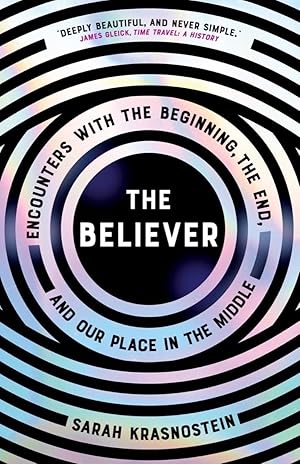
Sarah Krasnostein's Playlist for Her Book "The Believer"
In the Book Notes series, authors create and discuss a music playlist that relates in some way to their recently published book.
Previous contributors include Jesmyn Ward, Lauren Groff, Bret Easton Ellis, Celeste Ng, T.C. Boyle, Dana Spiotta, Amy Bloom, Aimee Bender, Roxane Gay, and many others.
Sarah Krasnostein's The Believer thoughtfully and poignantly delves into belief systems, and is a book I could not put down.
Publishers Weekly wrote of the book:
"An illuminating meditation on the nature of belief and the quest for meaning."
In her own words, here is Sarah Krasnostein's Book Notes music playlist for her book The Believer:
This book started with music: down in a Bronx subway station where I stumbled upon a Mennonite choir and found myself in an unlikely moment of being transfixed by their harmonies. I went on to spend time with the families in that choir and what I learned in their homes would lead me - over the next four years - to a Buddhist Death Doula, evangelical scientists, an academic who searches for ghosts, a woman incarcerated for 35 years for murdering her abusive husband, the fiancé of a pilot missing for longer than I’ve been alive and the ufologists who argue he encountered aliens. Whenever I sat down with each of these very different people and listened to their very different stories, their voices hit similar notes in the human song of longing for the unattainable. And that gestured towards the idea that we are united in the emotions that drive us into the beliefs that separate us.
In the Aeroplane Over the Sea – Neutral Milk Hotel
It may as well be in my DNA by this point, so long have I loved the album, but this particular song has come to remind me of Frederick Valentich – the young pilot who never returned from his first solo flight over deep water in 1978 – and Rhonda Rushton his 16-year-old fiancé waiting all this time for his improbable return. When Jeff Mangum sings, ‘How strange it is to be anything at all’, we have the best – or perhaps, the only - answer to our impossible task of embracing this fleeting life with all its intractable sorrows and beauties.
Dark was the Night, Cold was the Ground – Blind Willie Johnson
As someone who seeks to understand and be understood through words, the thing I love most about this is that Johnson didn’t need them to convey the human heart of this song. I write about the Golden Record, embedded in each of the Voyager space probes that were launched in 1977: An audio-visual disk intended to communicate the story of our world to extra-terrestrials. I care less about the success of its diplomatic mission than I do about the fact that Johnson’s voice will survive, somewhere, long after the rest of us are gone.
Into my Arms – Nick Cave
Even after two years of talking with Annie Whitlocke, the Death Doula who helps people have the most peaceful deaths possible, I didn’t truly understand what it takes to do her work until I saw her in action with Katrina. I knew Katrina in the final months of her life, as she planned and attended her own wake with her husband and children. This was one of the songs played live by a musician that night, and again weeks later at the small service held after her death. It moved me to tears then and I’m tearing up again now. It’s the idea of a certain perfection – not in heaven, but in any moment we are lucky enough to spend with those we love exactly as they are.
Signs – Bloc Party
A cardiogram of a song. Keke Okereke singing about believing in anything that brings his beloved back home. How we all do, at least occasionally, if we’re honest with ourselves.
Summer, Highland Falls – Billy Joel
Ach. In an ideal world, I’d have a book with an epigraph by William Martin Joel. This is off Turnstiles (1976) – a record with a cover I adore in all its kitsch glory; a soft homage to the subway where this book started. When he sings that ‘our reason coexists with our insanity’, I think how all of us are wired for certainty even at the cost of accuracy, all of us guilty of our own forms of magical thinking, cognitive dissonance, psychological dismemberment. All of us “stand[ing] upon the ledges of our lives with our respective similarities’.
My Little Demon – Fleetwood Mac
My phone started playing up immediately after I left a ‘paranormal investigation’, which I had been reporting on for this book. My phone wouldn’t work at all until it suddenly came back to life playing this - a song I had never played or heard until that moment outside the haunted hotel.
It’s a Heartache – Bonnie Tyler
This was one of the new songs in 1977, the year before Rhonda Rushton found and lost the love of her life. Everything you need to know about loving and losing is found in the grain of Tyler’s growl, the fact that she was singing, and the incredible appetite for the song – mine included.
Ghost – Indigo Girls
While I never saw what the ghost hunters I was immersed with saw, I was alive to the ways in which the past haunts the present. That’s always where my mind has always gone, listening to this song since I was fourteen.
A Walk to Caesarea – Max Schreiber
I’m present in the book with my own loses. I write about intergenerational trauma and the blunt tool that was holocaust education in the 1980s when I was a child. How I remember singing Hannah Szenes’s lyrics to this melody every year at school – My god, My god, I pray that this sound never ends… Here, the song is reimagined in Max Schreiber’s dissociative dreamscape.
We are Not Alone - Pepper Choplin at Sandy Ridge Mennonite / We are Not Alone – Lloyd Family
Bizarre, perhaps, for me but I didn’t stop listening to Mennonite music after my time ended with those families. I found these versions of Pepper Choplin’s song on YouTube. The distance between me and these people is enormous, we agree on almost nothing. And then they sing, and for as long as the sound lasts, none of that matters.
Canon & Gigue in D Major, P. 37: Canon (Johann Pachelbel) – Wynton Marsalis
“It is in your self interest to find a way to be very tender,” wrote the artist Jenny Holzer. We invest enormously in guarding against it. But Marsalis’s interpretation of Pachelbel’s Canon cracks me open, which I write about in the final chapter of the book. Listen for his clarion call, near the end. How do we hear it, or pretend not to, in our lives?
And how could we start imagining an answer?
Sarah Krasnostein is a writer and lawyer with a doctorate in criminal law. Born in Charlottesville, Virginia, she divides her time between Melbourne and New York. Sarah's first book, The Trauma Cleaner, won Australia's Victorian Prize for Literature, where it was a runaway bestseller.
If you appreciate the work that goes into Largehearted Boy, please consider making a donation.


