In the Book Notes series, authors create and discuss a music playlist that relates in some way to their recently published book.
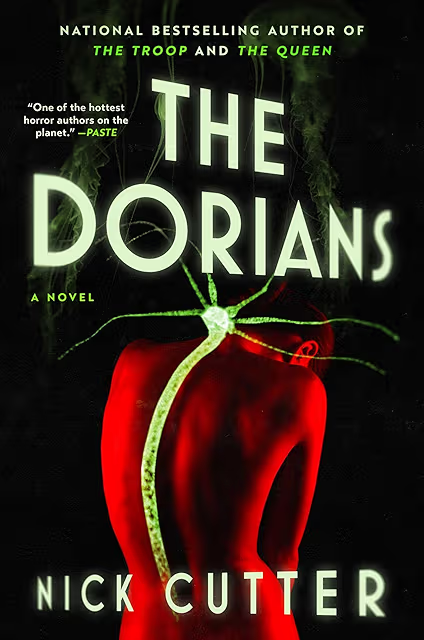
Nick Cutter’s novel The Dorians is literary horror both unsettling an compelling.
BookPage wrote of the book:
“A descent into body horror, [The Dorians] is brimming with squirm-worthy moments and pure textural malevolence that feel like classic Cutter, but it also offers new ways for [him] to explore deeper themes…Cutter’s gift for tension as tight as piano wire kicks into gear. The book moves at breakneck pace…an up-all-night horror story…[and a] warm character drama that is one of the author’s best works.”
In his own words, here is Nick Cutter’s Book Notes music playlist for his novel The Dorians:
Over the years I’ve been writing, my musical tastes have changed, as has the manner I listen to music. Back in the late-’90s and early oughts, I’d hear a song on the radio—we still reliably had those around back then, in homes, taxicabs, and restaurant kitchens, blaring at worksites. The radio was the background noise of road trips where one station would fade out of range and you’d have to scan the dial to pull in a fresh, new voice playing the same hits. As a sidenote, I used to spend summers up in northern Ontario, and it dawned on me how so many of those stations (most of which played a heavy rotation of ‘Classic Rock,’—Creedence, Foghat, Thin Lizzy, AC/DC)… all had animal names: 97.9 The Wolf, 101.1 The Moose, 99.9 The Grizz, 102.7 The Fox. They were almost interchangeable from the music they played to the DJ’s voices: the same sandpapery, just-got-out-of-bed rasp of a Wolfman Jack acolyte.
Back then, if a song took my fancy—if I heard it topping the charts on the Top 7 at 7 or the Top 10 at 10—then I’d head to the record store and buy the album. Of course, by then the record store didn’t sell records; they sold CDs, though maybe there were still a few cassettes kicking around in the rapidly-dwindling tape section. And maybe… maybe… I’d be pleased and relieved to discover that the album would have not only one good tune (the tune I’d heard on the radio), but three or four or five or maybe even six. That was rare indeed. I can count on one hand the albums that, to me, had a great percentage of bangers to duds. The first Counting Crows album was almost wire-to-wire (for me and my own musical tastes): not only “Mr. Jones,” which drove millions of us to pick up August and Everything After, but “Round Here,” “Omaha,” “Anna Begins,” “Raining in Baltimore.” There were others like that, but it they were rarities. Also rare (thank goodness) were the albums you’d buy for the one big hit only to discover to your dismay that it was the only really listenable track on the whole album (looking at you, Spin Doctors… “Two Princes” was a good one, though).
Back then, I wouldn’t listen to the radio while writing. Too many commercials, too much DJ chatter, too much uncertainty about a given song coming on that would throw me out of my rhythm. I’d have my trusty old boom box on the desk next to me, much spattered with paint from its secondary role as a jobsite boredom reliever the summer I spent whitewashing houses. I’d cue up a CD and, if it was a great one, listen all the way through as I wrote. If a certain song was really stirring me, I’d put it on repeat to accompany the scene I was writing. Later, my brother learned how to burn CDs and he’d put together mixed CDs, which I was grateful for as it generally prevented me from having to stop writing to replay a favorite track.
I look at those long-ago days with the wistfulness that those of a certain age often view their younger selves and their habits. Nowadays, of course, I’m more “hip” and “with it” and have a Spotify account. My musical tastes have changed a great deal, too, for reasons I can’t quite account. I was never honestly a fan of Classic Rock—I got stuck claiming I was, in certain company, purely out of abject peer pressure (“Yeah, cue up ‘Free Bird’ again, I can’t get enough of it…”)—but the music I truly enjoyed as a twenty- or thirty-something… it’s not like I won’t listen if those songs play on the radio (though I usually listen to podcasts while driving nowadays), but it won’t be with the fervency of my youth.
The songs I list below roughly coincide with those I listened to during the timeframe I wrote The Dorians… though not while writing; that’s also something I don’t do as much of anymore. I listened to these at the gym or on my way to pickup basketball or out on an autumnal walk… They’re downloaded off Spotify. None of them are songs I’d have listened to in my youthful writing days.
Times change. People change. It’s inevitable, I suppose. You can’t stop progress.
SUNSET LOVER, Petit Biscuit
I still haven’t found the perfect writing outlet for this song, though I’ve listened to it hundreds of times. My cousin put it on at a family gathering, and as soon as I heard the first few seconds, I knew it was for me. There’s something in it that, to me, speaks of youth. Simply that. It’s a song made by a young person, primarily for young people I would think, that speaks to that time in one’s life. It will be a song that I’ll play in the future, perhaps, when writing a book or a scene that tries to capture the youth I feel so strongly in its musicality… and as you get older, and your own youth falls into the rear-view, you need every trick in the book to try to summon those memories, that feel, if you ever hope to write about it. Young Blood by The Naked and Famous also gives me this same general feeling.
OCEAN AVENUE, Yellowcard
OK, so maybe I lied. This one was recorded in 2003, meaning I would’ve been in my very late-20s when I first heard it. Whether it was in rotation while I was writing some of the stories that made it into my first collection Rust and Bone in 2005 (or some of the many stories that didn’t make the cut)… it may have been, along with cuts from Dashboard Confessional and Something Corporate. I was in my feels at the time. Such a disillusioned young man was I, and I suppose these were the types of songs and lyrics that spoke to me back then. This one does have one of the most ripping violin solos you’ve ever heard at the end, so worth a listen right to the last note.
BLOOD DRIVE, Joshua Burnside
I believe I first heard this one on one of my wife’s Spotify playlists. Coffee House Songs or something. I don’t know that this is the sort of song I’d want to listen to at a coffee house… I may want to ask the barista for a hemlock chaser and get it all over with. It’s kind of depressing if you know what I mean? But I like the moodiness, the atmospheric quality to both the writing and Burnside’s voice, and the (to me, though maybe I’m thick) inscrutability of the song’s meaning. It sets a mood, is what I really like, and, sometimes, when you’re looking for a certain entry point to your writing, a tone or mood or feeling (grim in this case), then it’s nice to have a song that can ease you into that mood as into a warm bath.
HOME – REMIX, by Baauer and Bipolar Sunshine
I first heard this one while watching an episode of Shoresy—which is an excellent show, and I say so as someone who couldn’t give a fig about hockey (the by-product of being a basketball fan in a hockey-mad home country). The soundtrack for Shoresy is awesome, too. I get a lot of my music by coming across a snippet in a TV show or film (I Saw the Television Glow is another recent one, both an excellent movie and an excellent soundtrack) and, then, mercilessly hunting down the song by slinging the lyrics into Google usually. Sometimes, this takes a while, but in most every instance, it’s worth the effort. This one is trippy, synthy, kinda… druggy? But buoyant, effervescent, and it makes me feel good. That doesn’t usually compel me to extend that same grace and bonhomie to my characters (I’m a horror writer after all), but so it goes.
also at Largehearted Boy:
Craig Davidson’s playlist for his novel Cataract City
Nick Cutter is the author of the critically acclaimed national bestseller The Troop (which is currently being developed for film with producer James Wan), The Deep, Little Heaven, The Queen, and The Handyman Method, cowritten with Andrew F. Sullivan. Nick Cutter is the pseudonym for Craig Davidson, whose much-lauded literary fiction includes Rust and Bone, The Saturday Night Ghost Club, and, most recently, the short story collection Cascade. His story “Medium Tough” was selected by author Jennifer Egan for The Best American Short Stories 2014. He lives in Toronto, Canada.