In the Book Notes series, authors create and discuss a music playlist that relates in some way to their recently published book.
Previous contributors include Jesmyn Ward, Lauren Groff, Bret Easton Ellis, Celeste Ng, T.C. Boyle, Dana Spiotta, Hanif Abdurraqib, Andrew Sean Greer, Roxane Gay, and many others.
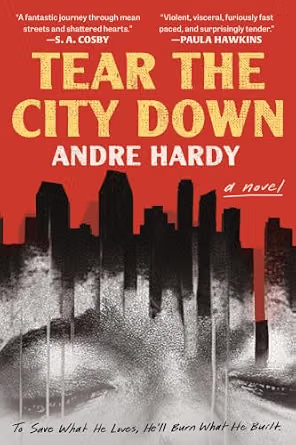
Andre Hardy’s novel Tear the City Down is a stunning noir debut.
S.A. Cosby wrote of the book:
“A fantastic journey through mean streets and shattered hearts. Full of vibrant prose and incredible characters. An unforgettable experience.”
In his own words, here is Andre Hardy’s Book Notes music playlist for his debut novel Tear the City Down:
If you read or write noir, you know the aesthetic. Down to his last buck, the hard-boiled detective sits in a dim office with a glass of rye, a trail of cigar smoke curling toward the ceiling, listening to jazz while contemplating how to pay the bills.
It’s classic. It’s comforting. It’s also cliché.
The single biggest challenge in writing Tear the City Down as a contemporary noir novel was managing genre conceits.
Considering the role of jazz in noir, I thought to move beyond superficial aesthetic and make the genius of John Coltrane the structural engine of my protagonist’s entire world. His first name is Coltrane, last name Davis. Exactly. He bears the names of arguably the two most important jazz musicians to ever live. My protagonist doesn’t like jazz; he IS jazz.
At first glance, his name appears as a simple nod to two titans of the genre. But in character design, a name shouldn’t just be an Easter egg; it should carry emotional and structural weight.
Noir protagonists are traditionally stoic, methodical planners. But real life—and real street-level crime—is chaotic. Coltrane Davis moves through the narrative the way Coltrane solos. In jazz, when someone drops a beat or hits an unexpected chord, you don’t stop playing. You lean into it. Adjust. Make the mistake sound intentional. When a plot line shifts beneath his feet, Coltrane doesn’t stick to a groove; he mines his subconscious and improvises his way out.
To lift a hard-boiled character from a flat archetype to a fully realized emotional contrast is key. I used specific tracks from Coltrane’s discography to mark the key turning points of Coltrane’s journey in Tear the City Down:
“Naima” — The Light That Washes Away the Blues
John Coltrane’s music is often explosive, seemingly chaotic in what a reporter once described as “sheets of sound.” But “Naima,” a ballad he wrote for his wife, is quiet, patient, and deeply tender. In the book, Coltrane tells the reader his daughter is named Naima. Explicitly comparing her smile to the dulcet melody that has the power to wash his blues away.
“My One and Only Love” (with Johnny Hartman) — The Shift Toward the Dharma
Noir characters are often trapped in their grimy habits. But Tear the City Down centers on the transformative power of love. After living in the mud for years, Coltrane meets Mona, who introduces him to meditation and the Dharma. During a meditation session, he realizes he’d rather chase love than money. Later, in a moment of pure vulnerability, he lip-syncs the song to her—a guy who has never known real love suddenly sending a barrage of Cupid’s arrows straight to her heart.
“Nutty” (with Thelonious Monk) — The Little Things & The Burden of Addiction
When Coltrane Davis steps into dangerous, uncharted territory, he turns to “Nutty.” The track marks a pivotal era: after being fired by Miles Davis for showing up to work “less than optimal,” John Coltrane kicks his habit cold turkey and begins his rebirth working with Thelonious Monk. He notes that Monk taught him to pay attention to the little things—because they are what make the entire structure stand up.
Heading into the unknown, Coltrane Davis relies on that exact discipline to survive.
This track also unlocks his complex rage toward his father, a Vietnam veteran who brought a drug habit home from the war that he’d never kicked. Coltrane has resented his dad for failing where John Coltrane succeeded in getting clean. That is, until he steps into his own trial and realizes his father was simply trying to carry unbearable pain, a brand of pain he now has to shoulder himself.
“Alabama” — Walking into the Belly of the Beast
When the stakes reach their absolute peak, the music shifts from personal to historic. In one of the novel’s pivotal moments, Coltrane reflects on “Alabama,” calling it the greatest act of mourning in American art history—written in response to the 1963 church bombing that took the lives of four young Black girls. Armed with that sacred grief and rage, Coltrane knowingly marches into the belly of the beast to rescue a young Black girl in trouble.
Key Takeaways for Writers
If you’re using a classic genre motif—whether it’s jazz, chess, classic cars, or boxing, don’t let it sit on the table like a prop. Ask yourself:
- Does this motif dictate how my character reacts under pressure?
- How does it mirror their internal arc, not just their style?
- Can a specific piece of art bridge personal trauma with broader history?
When you tie your motif directly to your character’s subconscious, it stops being a trope and starts being your story.
Official Soundtrack / Tracklist for Tear the City Down
- “In a Sentimental Mood” — Duke Ellington & John Coltrane (4:17)
- “Central Park West” — John Coltrane (4:16)
- “Naima” — John Coltrane (4:25)
- “My Favorite Things” — John Coltrane (13:46)
- “My One and Only Love” — John Coltrane & Johnny Hartman (4:56)
- “Nutty” — Thelonious Monk & John Coltrane (6:40)
- “Giant Steps” — John Coltrane (4:48)
- “Central Park West” — John Coltrane (4:16)
- “Alabama” — John Coltrane (2:27)
- “Aisha” — John Coltrane (7:45)
- “Dahomey Dance” — John Coltrane (10:50)
- “I’ll Wait and Pray” — John Coltrane (3:31)
- “So What” (Live from Olympia Theatre, Paris) — Miles Davis & John Coltrane (13:26)
Andre Hardy is a former NFL running back, author, educator, and business leader whose work reflects reinvention and resilience. A two-time Hall of Fame inductee with an MFA from Antioch University, he writes crime fiction with a noir sensibility, exploring identity, morality, and redemption.