In the Book Notes series, authors create and discuss a music playlist that relates in some way to their recently published book.
Previous contributors include Jesmyn Ward, Lauren Groff, Bret Easton Ellis, Celeste Ng, T.C. Boyle, Dana Spiotta, Hanif Abdurraqib, Andrew Sean Greer, Roxane Gay, and many others.
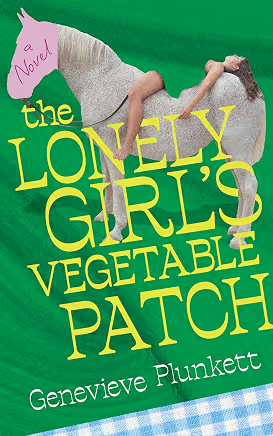
Genevieve Plunkett’s The Lonely Girl’s Vegetable Patch is one of my favorite debuts of the year, a brilliant working class novel with an unforgettable protagonist.
Electric Literature wrote of the book:
“Plunkett writes women whose brains are brilliant whirring machines. . . . This is an astonishing novel from a wild talent.”
In her own words, here is Genevieve Plunkett’s Book Notes music playlist for her debut novel The Lonely Girl’s Vegetable Patch:
The Lonely Girl’s Vegetable Patch was born directly from the time I spent working at a café in my hometown during the early 2000s. My boss, Robin, was the first to coin the phrase, “Lonely Girl’s Vegetable Patch,” as a way to pay homage to particularly impressive produce specimens. It was a joke that we would have ridden to the end of time, and one that I am apparently still clinging to. Robin was a beloved bad influence, well ahead of her time. She never catered to the norm, refusing to honor fad diets, chasing paying customers out for talking on their cellphones. She performed same-sex civil unions in the middle of the breakfast rush with her batter-smeared apron still on. In me, she saw great potential for mischief-making, and was always trying to convince me to buy a motorcycle or have an affair. She loved books and art and music. If there was a song or an album that she was into, she’d play it incessantly, even if it drove everyone else crazy. She was an icon. She did not give a shit. And so, my friends, this playlist is a direct reflection of what I was forced to listen to during some of the most impressionable years of my life.
Car Wheels on a Gravel Road, Lucinda Williams
Car Wheels on a Gravel Road may have been the most played song in café history, and I was probably the only employee who did not eventually want to stick my head in the coffee grinder because of it. It’s upbeat and devastating and perfectly captures that dreamy, melancholic state of a tossed-around childhood. Lucinda’s voice is so matter-of-fact it feels like found art. This line still gets me every time:
“Child in the backseat, ‘bout four or five years/ Lookin’ out the window/ Little bit of dirt mixed with tears/ Car wheels on a gravel road.”
The song itself, played again and again, was its own cult of insatiability, with Robin at its center. I understood her need to dig her nails into life itself, by any means available, even if it was just flying out from the kitchen to press repeat.
There was, however, a boy who worked with us during the “Car Wheels” era who thought the lyrics were “cartwheels on a gravel road.” He was living in a completely different universe.
The Wreck of the Edmund Fitzgerald, Gordon Lightfoot
I think this song has been trolling me my whole life. It’s not just annoying, it also goes on and one with no clear destination. It’s the kind of song you hear playing in a doctor’s office and you’re like, “shit, why do I feel suddenly exhausted? Why am I clammy? Why can’t they find a pulse??”
Can’t Find My Way Home, Blind Faith
We had a few “café angels” who would leave us mixes anonymously. This song was on one particular mix (I think it was labeled CAFÉ MIX) that got a lot of play time, and it reflects the usual behind-the-counter mood. We, the baristas (with maybe the exception of “cartwheels” boy), were so full of longing, so nostalgic for something we couldn’t name. And we were all heartbroken for some reason or another. There was nothing left for us to do but tattoo ourselves, dream of running away, and tease all the men. Big sigh.
Where is my Love? Lucinda Williams
Big, big sigh.
Hurricane, Bob Dylan
This song is what it feels like to be trapped in a half-waking workplace anxiety dream. I wish Bob would have left some air for the rest of us.
Amassakoul ‘N’Tenere, Tinariwen
It was 2005, we obviously had a bunch of the Putumayo compilations. This song was from the Mali album and it was a banger.
Corinna, Corinna, Leo Kottke
We baked with a lot of “heartbreak sugar” and “heartbreak flour,” which was what we called the leftover ingredients rescued from kitchens we once shared with our exes. With these ingredients we made many batches of heartbreak muffins and scones, and fed them to the townspeople, as if to distribute the burden. The front window of the café was home to a “heartbreak jade plant” of mine. For years, it thrived there. Also, how dare Leo Kottke do this to us?
Hide and Seek, Imogen Heap
Robin, you were the heart of this little town. Our café is gone, replaced by businesses with zero personality. Everyone is playing it too safe and there’s this thing called AI that you would absolutely hate. Anyway, I hope this book stirs up some beautiful mischief. It’s getting boring on this side of the veil.
Genevieve Plunkett is the author of In the Lobby of the Dream Hotel and Prepare Her. A recipient of an O. Henry Award and the Sewanee Review’s Andrew Lytle Prize, her writing can be found in the Sewanee Review, Electric Literature, Write or Die, Story, and the Southern Review, among others. She lives in Vermont with her partner and their children.