In the Book Notes series, authors create and discuss a music playlist that relates in some way to their recently published book.
Previous contributors include Jesmyn Ward, Lauren Groff, Bret Easton Ellis, Celeste Ng, T.C. Boyle, Dana Spiotta, Hanif Abdurraqib, Andrew Sean Greer, Roxane Gay, and many others.
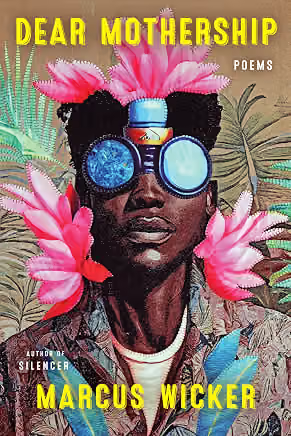
Marcus Wicker’s exceptionally moving poetry collection Dear Mothership spans the personal to the extraterrestrial with intelligence and poise.
Morgan Parker wrote of the book:
“”In this stunning, adventurous third collection, Marcus Wicker is yet again in full command of a dynamic, irresistible voice—pensive, contemporary, and poignant, almost as if to spite its playful side—wielding wordplay and rhythm with the dexterity of a lyricist, and observation with the tenderness and scrutiny of a master poet. I cherished these poems for their attitude, their wisdom, their futuristic Blackness, and their survivor’s guilt. I felt at home with their frustrated awareness, their confessional tendency, their unshakeable imagination, their song. If these lines were any more musical, you could dance to them.”
In his own words, here is Marcus Wicker’s Book Notes music playlist for his poetry collection Dear Mothership:
The title section of my third poetry collection, Dear Mothership, is a travelogue written to a mothership by an extraterrestrial who has touched down in 2020 Atlanta. Music is the ATLien’s life force, and although his home planet, Stankonia, is filled with it, he comes to America looking for respite from the overstimulation, only to find another kind of cacophony—social division, political vitriol, sickness, and umpteen forms of escapism. But during his two-year stay, he also encounters humans at their best—tender, filled with light, and naturally inclined toward connection. My playlist is comprised of songs that soundtrack the ATLien’s journey, but also the seven years I spent writing the rest of the book: songs that accompanied the ordinary and extraordinary weather of those years—love, grief, friendship, loss, and the hardheaded, sometimes ridiculous work of trying to remain open to joy.
“ATLiens,” OutKast
You know I had to start with OutKast, right? The ATLien not only draws his name from their seminal album, but he tends to sample OutKast lyrics when he speaks. I excerpt this title track for the first time in a preface poem called “Why Did You Come Here? How?” that explains the central speaker’s back story, describing his maiden voyage from Stankonia to Atlanta in a money green Cadillac Eldorado spaceship. The piece ends: “I spun the dial softly, as if I played piano in the dark. Then the drums dropped, the woofers thumped, and I was out—”
“Cosmic Slop,” George Clinton & The P-Funk Allstars
One of my all-time favorite Funkadelic songs. It’s about a mother trying to shield her children from the world, including the choices she’s made to provide. At night, she asks the Lord not to judge her too harshly and the devil replies, asking her to dance the cosmic slop. It’s far out. Geroge Clinton, the OG conductor of the mothership, sings “I can hear my mother call” over and over again on the chorus. It’s pleading but the atmosphere is funky and free, a vibe that felt really good to inhabit during the years when the world outside of my desk felt the opposite on both accords. I love the original from 1973, but I love the guitar solos on this version from Live & Kickin’ (97) even more.
“Reflections,” Katalyst, Adrian Younge, Ali Shaheed Muhammad
I discovered Adrian Younge and Ali Shaheed Muhammad’s ongoing Jazz is Dead discography during the making of Dear Mothership. “Jazz is Dead” isn’t a literal statement. It’s meant to signal that the rigid parameters by which previous listeners used to define jazz are dead. The music is very much alive in all of its current incarnations and subgenres, which in fact keeps its most important innovators on the tongues of those in the know. Lately I’ve felt like this song, off JID 13 featuring Katalyst, represents the book’s variety. It’s hip hop, it’s jazz, it’s high lyric, and yarn spinning. It’s shit talk, palinodes (take backs), and persona poems. It’s a remixed crown of American Sonnets, a broken sestina, defenses, and love letters. Definitely my most “this and” book to date.
“Missed Calls,” Earth Gang
When I’m in my feelings and going through it, I’m famously bad at keeping in touch. It’s a personality flaw I’ve come to understand is less than harmless. Disconnection is a recurring theme in Dear Mothership, beginning with the epigraph to the first poem, borrowed from Atlanta rap duo EarthGang: “I’m so good at missing calls that I’m perfect this year.” The drums and synthesizers go crazy. It’s a spacey head nod for sure.
“Be Alright,” The Foreign Exchange
My friend Ray died suddenly in 2022 and I missed what would have likely been our last conversation because I wasn’t in the mood to talk. We met sophomore year in a dorm lobby at Western Michigan University when he complimented my Miles Davis t-shirt and asked if I wanted to hop in a car with three strangers and drive an hour to Lansing to hear Little Brother. I did not. But we became fast friends and he introduced me to Little Brother’s catalog. Phonte, who’s one half of the group, met Dutch producer Nicolay on the Okayplayer message boards. He and Nicolay recorded their 2002 album Connected by sending audio files back and forth across the ocean before actually meeting in person. My friend and I both loved that album, and I played this beautiful, balming track on repeat while I wrote “Elegy with TV Repairman & the Black Moth of Light” and “Elegy, Late,” both for Ray.
“Welcome to the Hills,” Yusef Dayes
I finally bought a record player in 2020 to go with my grandfather’s antique Marantz receiver I’d lugged around for the better part of a decade without using. I started collecting LPs I considered to be “shock resistant”—acid jazz and hip hop that made me feel like I could take a bump and keep rolling. In other words, writing music, if there is such a thing. Welcome to the Hills was my first collector fail. I saw the album at a shop in Birmingham, Alabama for 50 bucks, said no thanks, saw that it was going for $150 on Discogs the next week, phoned the record store, and it was gone. If you like funky bass lines, virtuosic drummers, and that live album feel, you’ll probably dig it.
“Interstellar Love,” Thundercat
Speaking of shock resistant…
“New Flower!,” Amine
One of my favorite poems in the book, “Late Summer in the Anthropocene,” is written for my partner, Emily Skaja. Emily is also a poet, and our new books share a bit of overlapping material, like the image of a stubborn plant named Hibiscus Child we fought like crazy to keep alive (a metaphor and plain facts both). Pretty much every time Hibiscus Child sprouted a new bloom she made a cameo in somebody’s word doc.
“Found a Light (Beale Street),” BadBadNotGood
I wrote the first poem for Dear Mothership in 2019 and the last poem in late 2025, before the improbable birth of our son. I experienced all kinds of highs and lows over that stretch of years—family and friends passing, lost pregnancies, unexpected artistic/career opportunities, woe again. Once I decided my heart couldn’t take the rollercoaster any longer, I decided I’d try to will myself toward optimism and joy on the page. The results were mixed, but sometimes it worked. This song was in heavy rotation as I was completing the book.
“The Makings of You,” Curtis Mayfield
I’ve been a Curtis Mayfield fan since high school. I used to drive a 96 Chrysler Concorde around my Ann Arbor, Michigan neighborhood playing his greatest hits. But I never liked “The Makings of You.” Nearly twenty years later, I came around to the song. In the final section of Dear Mothership, I write about struggles with infertility, traveling back and forth from the Radcliffe Fellowship at Harvard to our home in Memphis once a month in an effort to conceive, and ultimately failing. The first time I thought I was done with the book it ended on a note of tender resignation: “gather your life / by the scruff. Hold on / to what you can.” Mere weeks later, our son August was conceived and I wrote a hopeful coda called “Welterweights” about all the ways we’d fought and were willing to fight for his arrival, including playing his heartbeat as a lottery pick after routine checkups. Emily and I listened to Curtis Mayfield Radio on Spotify during every visit to the ultrasound tech’s office because Curtis Mayfield makes everything a little smoother. This perfect ballad always found its way into our midst during the 50-minute roundtrip.
Marcus Wicker is the author of three books of poetry: DEAR MOTHERSHIP, Silencer, and Maybe the Saddest Thing, selected by D.A. Powell for the National Poetry Series. His honors include a National Endowment for the Arts Creative Writing Fellowship, the Poetry Society of America’s Lyric Poetry Award, a Pushcart Prize, and Ruth Lilly Fellowship, as well as fellowships from the Harvard Radcliffe Institute, The Fine Arts Work Center, and Cave Canem. Wicker’s poems have appeared in The Nation, The New Republic, The Atlantic, Oxford American, and Poetry Magazine. He is an Associate Professor and the Orgill Chair of English at the University of Memphis, where he teaches in the MFA program.