In the Book Notes series, authors create and discuss a music playlist that relates in some way to their recently published book.
Previous contributors include Jesmyn Ward, Lauren Groff, Bret Easton Ellis, Celeste Ng, T.C. Boyle, Dana Spiotta, Hanif Abdurraqib, Andrew Sean Greer, Roxane Gay, and many others.
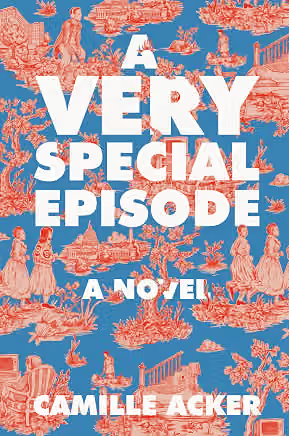
Camille Acker’s novel A Very Special Episode is an irreverent and insightful debut focusing on race and class.
Publishers Weekly wrote of the book:
“An intense satire about the abuses of class privilege . . . The novel’s dark humor and horror elements play perfectly into an absurdist plot that highlights racial and class inequities. It’s a marvel.”
In her own words, here is Camille Acker’s Book Notes music playlist for her debut novel A Very Special Episode:
At one point in my writing life, I avoided sitting down to write. I would set goals for a certain number of words or a certain amount of time, but would fail to follow through again and again. Fear–of what I was capable of writing and what I wasn’t–kept me away from the page. The only way I could break my habit was to listen to a mix of music. I promised myself that I would stay in the chair thirty minutes into the playlist when my favorite song played. Some days I would only make it to the thirty minute mark, but often I would write for far longer. I don’t need a playlist any more to get me to write, but music still accompanies some of my sessions. including those for my debut novel, A Very Special Episode. In my novel, pop culture proves to be diabolical, but not so with these songs.
“Weak” by SWV
“Girl groups” from the 1990s helped me to conceptualize the four main characters in A Very Special Episode. Every one brings something unique to the group and together, they are unbeatable–a different kind of sisters with voices. Part of the plot of my novel depends on a remixed song and at one point when I was brainstorming, I thought about using “Weak.” It’s got classic R&B harmonies. It’s an iconic ’90s song. It’s a love song. And, it has an anthemic quality that makes an entire crowd of people want to sing along. All of that felt right for A Very Special Episode which is contending with nostalgia, love, and community. I pivoted away from using it though because I love this song too much to defile it with my terrible imagination.
“Sleep to Dream” by Fiona Apple
The kick drum at the opening of “Sleep to Dream” gets me every time. Then, Fiona Apple’s smoky voice comes in and the song swells before, “I’ve got my feet on the ground and I don’t go to sleep to dream.” There’s such controlled anger in the lyrics, “deviant ways” certainly accuses. That kind of righteous rage hums along in my novel. So much is wrong, but Nina, my main character, keeps a lot of her rage to herself, just like that percussion in the background. But, there comes a point where Nina, just like Fiona, also realizes she has “her own hell to raise.” Plus, Fiona Apple’s speech at the MTV Video Music Awards in 1997 where she tells everyone to “Go with yourself” could easily be the BookTok distilled message of my novel.
“Shit Damn Motherfucker” by D’Angelo
A Very Special Episode is a satire, a way to blend serious ideas with humor. This song is its own kind of blend, telling the story of a protagonist finding his best friend and his wife in bed together and murdering them. Dark, for sure, but D’Angelo’s smooth vocals and an addictive bassline make it more than that. It’s one of the songs some people could listen to and be horrified by, just as someone could read satire, including the one I wrote, and slowly back away. But I love art in any form that takes you somewhere you don’t expect and this song absolutely does.
“Big Momma Thang” by Lil’ Kim
At one point in A Very Special Episode, the characters begin to hatch an audacious plan. They try to hype themselves up by banging out a beat with their bodies, pounding their feet on the floor, clapping their hands on the table, whooping and cheering. They’re trying to get their nerve up. Lil’ Kim in this song is pure bravado: “You want to be this Queen Bee, but you can’t be/That’s why you’re mad at me.” She’s foul-mouthed, gratuitous, and a total boss. I have no doubt that if one of my characters had started playing this on their phones they could have taken over the entire world.
“Wind Me Up, Chuck/Hoochie Coochie Man” by Chuck Brown
This song is a DC classic from a DC legend. Go-go is a DC born and bred music with incredible percussion and horns. That remixed song in A Very Special Episode I couldn’t bring myself to use “Weak” for? Instead, I described it in the novel as having a go-go beat, but I didn’t name a song. As with other Black music–gospel, jazz, blues–go-go is improvisational and moves with instinct and feeling. Go-go music and a go-go, where people dance to the music, can go on and on and on, hence the name. Those communal spaces of both exertion and joy are central to Black culture, whether in the pews of a church or on the floors of a club. It was only fitting that the remixed song that becomes important in this novel set in DC pays tribute to a DC musical tradition.
“Tenderness” by Diana Ross
Many of these songs I was listening to in the years I was writing A Very Special Episode. This, I was not, but my sister reignited my interest in Diana Ross this summer. There’s something so warm and vulnerable about this song that makes me think of one of my characters. Delores is the mother of my main character and is not at all warm or vulnerable. She’s actually controlling and domineering, but as with real people’s flaws, there’s a reason she became that way. The walls she’s erected are her attempt at protection. “It’s so hard for me to trust,” Diana Ross sings in her breathy voice. The song’s also got a diva’s disco beat and Delores is an absolute diva.
“The Message Continues” by Nubya Garcia
I’ll veer ever so briefly away from pre-2000s music to highlight this song by UK saxophonist, Nubya Garcia. I often listen to jazz when I write. It helps give me pace and energy especially when I’m trying to get the words flowing. If I’m editing, I won’t generally have music on because I’m often reading my words out loud. The album that the song “The Message Continues” is on, Source, came out during the pandemic and has been a writing song for me ever since. It has some great keyboard and drum solos and then Nubya Garcia roars back in with her sax.
“Four Women” by Nina Simone
My main character in A Very Special Episode is named Nina for Nina Simone, though she has not demonstrated the fire and resolve of her namesake. Nina Simone’s voice has been a favorite of mine for decades, so emotive, with a versatility and texture that makes it dynamic. Through the experiences of four Black women, the song chronicles American history and encompasses a range of issues, racism, sexism, the sexual violence of slavery, the pitfalls of capitalism, colorism, and ultimately the righteous anger of those who have been oppressed. At an early stage of the novel, I had five main Black women characters, but as I developed the plot more, the story needed only four women. As it should be.
“Liberation” by Outkast
I have two epigraphs to open A Very Special Episode, one is by Audre Lorde, the other is by Andre 3000, formerly one-half of Outkast. The song I quote is “Vibrate Higher,” an unapologetic call for all kinds of freedom untethered to respectability, but this song, epic in its scope and profound in its lyrics, is asking for a wider movement. In Big Rube’s verse, the final one of the song, he poses the questions: “Who the one gon’ get it started?” My main character, Nina, wrestles with whether she can be the one to get something started in the novel, to depart from the way she’s been raised and dare to be boldly different. Easier said than done perhaps, but worth it in the interest of liberation.
Camille Acker is the author of the short story collection Training School for Negro Girls. She grew up in Washington, D.C., and holds a B.A. in English from Howard University and an M.F.A in Creative Writing from New Mexico State University. Her work has been published in The New York Times Book Review, Publishers Weekly, Electric Literature, and in the anthology On Girlhood: 15 Stories from the Well-Read Black Girl Library. Her writing has received support from the Tin House Residency program, Djerassi Resident Artists Program, Voices of Our Nations Arts, and Millay Colony for the Arts, among others. She was a recipient of a Fulbright Scholarship and named a Fellow by the Pew Center for Arts & Heritage. She lives in Philadelphia, PA with her partner.