In the Book Notes series, authors create and discuss a music playlist that relates in some way to their recently published book.
Previous contributors include Jesmyn Ward, Lauren Groff, Bret Easton Ellis, Celeste Ng, T.C. Boyle, Dana Spiotta, Hanif Abdurraqib, Andrew Sean Greer, Roxane Gay, and many others.
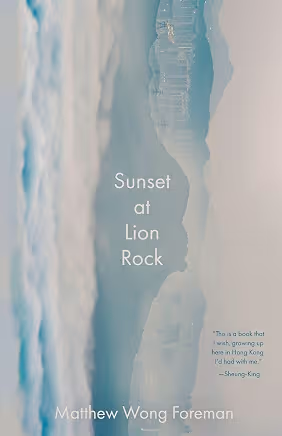
Matthew Wong Foreman’s novel Sunset at Lion Rock is a debut as visceral as it is profound.
Emma Pei Yin wrote of the book:
“Lyrical, restrained and deeply felt, Sunset at Lion Rock explores identity and memory in the shadow of history. A striking debut of uncommon grace.”
In his own words, here is Matthew Wong Foreman’s Book Notes music playlist for his debut novel Sunset at Lion Rock:
Like many writers, most if not all my work would have been impossible without music. I am grateful to live in an era where I can choose to listen to almost anything I want in a matter of clicks, entirely for free.
Sunset at Lion Rock is a letter from a nephew to his uncle who went missing before he was born, informing him of all that has happened to their family, their city, and their lives since his disappearance. It is also my own letter to the city of my birth, which, in a way, had also died before I was born.
Some years ago, my psychiatrist told me that ADHD brains often listen to the same song on repeat – sometimes dozens of times consecutively – to regulate dopamine levels, providing comfort, emotional regulation, and focus. This behaviour acts as a cognitive anchor, reducing distractions and turning mental “noise” into structured, predictable stimulation. After I heard this, I immediately burst into tears. For almost three decades, I thought this was deviant behaviour. Friends, family, partners, often made fun of me for playing the same song for hours, sometimes to the point where people around me had to physically leave the room.
Music, like writing, has helped me come to terms with the fact that pathology is what I make of it. A condition, psychiatric or otherwise, can be a feature and not a bug, so long as it is managed effectively and put to good use. Here are the 10 songs on endless repeat that made the chapters possible.
“Expedition” – Susumu Hirasawa
Whenever I am asked who my favourite writer is, the first name that invariably comes to mind is Kentaro Miura. While this is neither the time nor place to explain why Miura’s Berserk should be considered alongside Dostoyevsky’s Crime and Punishment as one of humanity’s greatest literary achievements, I will say that the 2022 Golden Age Arc anime adaptation produced a soundtrack that rivals any Academy Award for Best Original Score.
Sunset at Lion Rock opens with the protagonist, Eric, standing on the edge of the roof of his childhood home, contemplating suicide. Not in a morbid, depressing sense (though it can be, if one wishes to interpret it that way), but rather, he meditates on what is: that many, of not all of us, are constantly determining whether life is worth living. And I’d like to think that Eric, in that moment, just like Guts in the “Bonfire of Dreams,” is also staring at the glistening stars in the midnight sky, whispering 艶麗 えんれい enrei (beauty), over and over, before he steps off the ledge to begin his journey.
“Svefn-g-englar” – Sigur Rós
Songs over 4 minutes long are hard to come by nowadays. Our attention economy treats time as inseparable from money. Consumer engagement is a scarce commodity that dominates every board meeting from Meta to your local department store. Artists and writers and editorial directors and corporate sponsors and tech barons and presidential campaign managers all obsess over not just how many eyeballs are on their “products,” but how long those eyeballs linger. The more attention they harvest, the better the spreadsheets look.
Whether it’s because Sigur Rós predated TikTok or the Nordics have simply figured out the meaning of life, “Svefn-g-englar” remains a 10-minute masterpiece that still regularly gets comments on music video. Go check it out on YouTube – there’s really nothing like it. This pioneering Icelandic cosmic post-rock band are truly inimitable.
Part I of the novel dives deep into Eric’s family history, laying bare the experiences that shaped his upbringing. Though at first it might seem tragic or heartbreaking (and dare I say it, navel-gazey), I hope the takeaway readers get from these chapters is that tragedy, like the protagonists in “Svefn-g-englar”’s music video, is not a fact but an interpretation.
“鴿子” – Song Dongye
They say the tragedy of life is what dies inside us while we live. The same can be said of Song Dongye, whose promising career collapsed virtually overnight in 2016, when he was arrested in China on marijuana charges (drugs are a huge no-no). In 2021, his attempted comeback was cancelled when netizens protested online, citing that drug users and criminals do not deserve to have celebrity careers (or any career, judging by some of the comments). In an impassioned post on the social media platform Weibo, Song pleaded with the Chinese public to give him second chance, citing that drug addiction should not be demonized given the severity of the China’s mental health crisis, especially for struggling artists. His cry largely fell on deaf ears. Mainland China’s entertainment industry is heavily controlled, and it will be some time yet, if ever, before we see Song’s creativity again.
I will not go into my own views on drug addiction, China’s war on drugs, or the carceral state, but I will tell you that Song Dongye’s “鴿子” (pigeon) brought tears to the eyes of an English uncle in Luton who understood not a word of Mandarin. Even if you don’t understand the lyrics (a terrible loss), you will surely understand what is trying to say. An apt song (and message) for chapter 3, which is set in China.
“Two Fingers” – Jake Bugg
The end of Part I departs from the slow burn of the previous chapters and adopts a higher energy, light-hearted melancholy that mirrors the tale of how Eric’s parents met. Despite what will come to befall them, we get to see how, at one point in time, it wasn’t always so bad. Hopeful, even. A kind of hope only the youth possess, a fierce belief in the possibility of a way out of the endless cycle of Samsara, even if they didn’t know that was what they were after at the time. This hopeful melancholy is captured perfectly in “Two Fingers” by Jake Bugg, or indeed, all of his tracks in his 2012 debut Jake Bugg.
So I hold two fingers up to yesterday
Light a cigarette and smoke it all away
I got out, I got out, I’m alive but I’m here to stay
Hey, hey, it’s fine
Hey, hey, it’s fine
Hey, hey, it’s fine
I left it behind
“In the End” – Linkin Park
I still remember the first time I came across Linkin Park on YouTube. Back in 2008, I was a vehement video game addict, and during the summer holidays – when I wasn’t at Buddhist camp – I would spend upwards of ten hours playing GunZ: The Duel and watching YouTube clips of competitive tournaments. It was on one of these clips that I stumbled onto “In the End,” which would quickly become the first song, and Linkin Park the first band, that received my undying obsession. It got so bad that at one point, a friend of mine opened my iTunes and expressed concern over the 100,000 plays the song received. Linkin Park was my first foray into music, the first band I saw live, my first experience of fandom.
Part II of the novel leaps ahead into Eric’s adolescence. Here we witness the beginnings of his youthful nihilism, one which represents his rebellion against the various social, cultural, and religious expectations placed upon him. It is only natural that the punk-adjacent, nu-metal “In the End” makes an appearance here. Of course, Eric knows all the lyrics by heart. And so does his “friend,” Eddie.
R.I.P Chester Bennington.
“給自己的情書” – Faye Wong
Faye Wong was my mother’s favourite artist. That’s all that needs to be said about chapter 6, and the song that goes with it.
“Forgotten Love” – AURORA
Whether Sunset at Lion Rock has a romantic storyline will depend on one’s specific predisposition. For some, the latent tension between the two characters is patently obvious. For others, Toni Morrison’s credo in Sula will resonate here – what happens when we forgo traditional romantic tropes and simply examine relations between people in all their complex, messy, unspoken beauty?
“Forgotten Love,” like the rest of AURORA’s oeuvre, is a bittersweet tale of someone who wakes up one day to the realization that they are no longer sad about their ex. Its dreamy, sentimental yet playful beats inspired the vast majority of the chapters in Part II. While drafting these chapters in 2020, my four-year relationship had started to collapse – its inevitability all the more painful as it was during the height of COVID and we were living together in a remote part of Western Massachusetts. Perhaps this was why I was so reluctant to deploy a stereotypical romance in the novel, to the chagrin of many of my readers.
“WingRiddenAngel” – XXXTentacion
XXXTentacion’s music got me through some rough times. Like Lil Peep and other SoundCloud rappers of the early 2010s, X was one of the pioneers of what advocates dubbed “emo rap” and detractors ridiculed as “mumble rap.” They captured our generation’s iteration of adolescent malaise, the existential hopelessness of those of us who grew up in the digital age of the 2000s and 2010s. “WingRiddenAngel” was one of X’s earlier SoundCloud songs released right before he exploded onto the mainstream. Whatever you think of him as a person – and he was certainly a problematic and controversial individual – it is undeniable that X was a symptom of a disease far deeper than simply poverty and violence. “WingRiddenAngel,” released when X was just 17 years old, reflects on a doomed first love. It is a raw, emotional track exploring drug abuse, suicidal ideation, and the guilt and regret of a young man’s inability to take accountability for his own actions when it matters.
Now a young adult, Part III of Sunset tackles Eric’s role in the Hong Kong protests, his collapsing relationships, and his growing disillusionment with the city he once called home.
“Yuko Ando” – Shogeki
Another one of my all-time favourites is Hajime Isayama’s Attack on Titan, a manga-turned-anime that ostensibly appears to be a simple shonen centring on a band of teenagers fighting against human-eating titans. However, by the end of the show, readers and viewers are forced to confront themes including the cost of freedom, the cycles of hate, and the morality of violence.
A fitting companion piece to the penultimate chapters.
“Afterlife” – Avenged Sevenfold
I don’t belong here, we gotta move on, dear
Escape from this afterlife
‘Cause this time I’m right to move on and on
Far away from here
A place of hope and no pain
Perfect skies with no rain
Can leave this place but refrain
‘Cause we’ve been waiting for you
Fallen into this place
Just giving you a small taste
Of your afterlife here so stay
You’ll be back here soon anyway
Matthew Wong Foreman is a Hong Kong-born writer. He has a B.A. and M.A. from Hong Kong University and Oxford University and a PhD in History from Northwestern University in 2023, where he taught history and writing to college and high school students. His writing has been published or is forthcoming in Pacific Historical Review, Asian Ethnicity, Cha: An Asian Literary Journal, and The Oxford Review of Books, among others. His work has been featured by Radio Television Hong Kong and showcased at the Hong Kong International Literary Festival.