In the Book Notes series, authors create and discuss a music playlist that relates in some way to their recently published book.
Previous contributors include Jesmyn Ward, Lauren Groff, Bret Easton Ellis, Celeste Ng, T.C. Boyle, Dana Spiotta, Hanif Abdurraqib, Andrew Sean Greer, Roxane Gay, and many others.
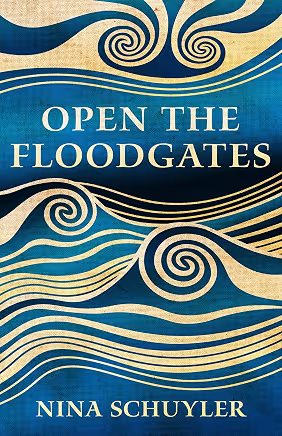
Nina Schuyler’s Open the Floodgates is a fabulous fable for our times, a climate fiction novel both compelling and timely.
Kate Folk wrote of the book:
“Open the Floodgates begins with an ingenious premise and unfolds into an intricate tale of interdependence and survival. With lyrical prose and vivid characters—human and non-human alike—Schuyler makes the fight to sustain the natural world feel urgent and intimate.”
In her own words, here is Nina Schuyler’s Book Notes music playlist for her novel Open the Floodgates:
With every ounce of my being, I feel compelled to do something about the climate crisis, which is bearing down, tragically reshaping everything. And so, here comes my novel, Open the Floodgates. I can’t read apocalyptic, dystopian climate literature; I can’t live there in my imagination without something vital cracking. You’ll find the playlist touches grief but doesn’t stay there, because I played with the new legal trend of granting personhood to natural entities, giving them rights and responsibilities. This new way of seeing brings hope. So… In an unnamed California town, the River is granted personhood and has the right—and urgent need—to argue in court for its existence. But powerful, well-monied forces line up, determined to keep the River as it is: gunk-filled, toxic, a convenient dumping ground for waste. The story moves like water, entering the minds of the town’s people, pigeons, deer, dogs, cats, the trees, the River’s home, and the River itself. When the River is ultimately jailed, the town faces a reckoning: what do we owe the River? And the River must answer in turn: what, if anything, does it owe humans?
The River (Bruce Springsteen)
Springsteen’s gravelly, road-worn voice cuts straight through me, carrying me down to the river. That’s where, sooner or later, every one of my characters has gone or will go. It’s where the River (and now I need to capitalize it as a proper name) has seen the full sweep of human life: picnics and swimming, children skipping rocks and laughter, kisses and lovers disappearing in the tall green grass. Women once washed clothes in the River and dipped their babies into its cool, clean water. The babies would startle, then squeal with delight, patting the water, splashing to even greater delight. You can’t do that anymore. Too much crud in the River. But in those days, you could, those beautiful beautiful days that haunt and call to character in the book, one way or another.
Mercy, Mercy Me (Marvin Gaye)
The River is turned into a person and goes to court to argue for its existence, but it doesn’t understand, not really, what is happening and why it has to go to court, only that it’s now a person. Even Florence can’t explain it. The River is playful and alive and bewildered and misses the cottonwood trees that once shaded its banks, misses the fish that flashed along the gray rocks; misses the families who came to swim and laugh and picnic and looked so happy. The deer still come to the River, so do the raccoons and bears, because they have to drink something. If the River understood the word, it would flow right up to the witness stand and say, Have mercy, have mercy on me.
Take Me to the River (Al Green)
When I go to the river, something inside shifts. An unselfing, an opening—I don’t know. George, who is nine and full of boy energy, knows this feeling but doesn’t have the words for it. He can tell you the junk he finds in the River, and how he swims there—he doesn’t care about the pollution, or whatever. Gary, the defense attorney, doesn’t remember the feeling at all. It’s been shoved under trials, briefs, opening and closing arguments—otherwise, I imagine, he couldn’t do his job without losing his mind. I’m sure you know the feeling I’m talking about. You know what it can do, how the River can wash your feet and put them back on the ground.
Beds are Burning (Patti Smith–Live in Dublin, 6/6/2018)
I love Patty Smith’s voice that rips your heart open. If you watch her sing this song in Dublin on YouTube, it looks like Smith’s hair is on fire. Seventy-five-year-old Hazel, who testifies on the River’s behalf, is not messing around either. She grew up with brothers and knows how to do a headlock. A former schoolteacher who now owns a beauty parlor (called Love Thyself, Woman), Hazel’s slicing voice makes the court tremble and feel things they’d rather not. But did she help or hurt the River’s case, wonders the Judge. Can the jury listen to this?
A Hard Rain’s A-Gonna Fall (Patti Smith; Nobel Prize Award Ceremony 2016)
I can’t explain why, but this song reminds me that the River is snow and rain and ocean, one big gorgeous circle of water. Maybe because the lyrics of this song are all-encompassing, scooping up everyone and everything. It’s a wise song.
It reminds me that the water is wise. It’s been here since the beginning of time. It’s carved mountains, worn canyons smooth, carried civilizations, remembering what we’ve forgotten.
The River, like the song, gathers all the grief—the poisoned water, vanished fish, the failures of our imagination and carries it beyond despair. At some point in this performance, Smith breaks down. She has to start over—and for me, it’s the weight and wisdom and hugeness of the song. She makes it to the end, and it’s like we’ve been through something and made it out. Like the world seemed to tilt, almost imperceptibly, toward possibility. Something large is coming. It has to. Because rivers have always known how to keep moving, and so, finally, must we.
Once in a Lifetime (Talking Heads)
Bewilderment coats the novel like a film, smeared all over the humans and nonhumans, under fingernails, hoofs, webbed feet and fur. When the Law declares the River a person, the known world tilts on its axis. What was once property is now a person. What could be owned now speaks. The questions come immediately: what’s this River doing calling itself a person? How can it be a person, when we’re persons? A person has feet. Feet. A face; a brain capable of inventing bridges and rocket ships. And nonhumans wonder: why has the River disappeared into that enormous brick building? What happens in there? None of this makes sense. Or maybe, looked at another way, it’s the first thing that ever has.
Money (Pink Floyd)
It arrives with polished shoes and expensive suits, smiling as if it’s the reasonable one. Everyone knows that voice. It fights with claws disguised as precedent and logic. In the strange land of Law, a corporation is a person too, treated with rights and responsibilities like flesh and blood. Money has always been persuasive. It charms. Seduces. It beguiles with shady promises.
Take Me to the River (Talking Heads)
I hear this song, and I start moving my shoulders, then my head, my feet, everything in motion. Listen. Listen to the song. I mean listen to it. That beat moves your watery body with all those little rivers inside. The quintessential thing about the River is that it moves, swaying and swishing and charging right around the big rocks and over the fallen trees. That River, if only we’d move like that, nothing would stand in our way to a better future.
Freedom (Jon Batiste)
Wafting through the novel is the sweet desire for freedom. Free from prison, from an old narrative, a bad marriage, a one-note flattened way of life, from a sickly existence. This song hits the high notes of joy and delight and aliveness, and that’s in the pages of my novel, too. A handful of characters risk everything for freedom, cracking open the story, filling the pages with light.
Open the Floodgates (The Smile at the Magazine, Jan. 2022)
Because I love Thom Yorke; because the song floods you, your heart, entire being, moving something inside; because I listened to this song—I’d write, take a break and listen to it—and let it flood me, so I could tap into the deep well of something beyond myself; because Yorke’s refrain echoed throughout writing this novel, “someone lead me out of the darkness..” I don’t know what Yorke wanted this song to be about, and I don’t care. Once you put art out into the world, you hand it over. It’s now open to interpretation, open to making it your own.
also at Largehearted Boy:
Nina Schuyler’s playlist for her story collection In This Ravishing World
Nina Schuyler is the author of four other fiction books and teaches creative writing at Stanford Continuing Studies and the independent bookstore, Book Passage. Nina Schuyler’s newest short story collection, In this Ravishing World, won the PEN Oakland Josephine Miles Literary Award, the W.S. Porter Prize for Short Story Collections, and the Prism Prize for Climate Literature. It was also a finalist for the Northern California Book Award. She graduated from Stanford University with a B.A. in Economics and earned a law degree at UC Law San Francisco. She is also the author of How to Write Stunning Sentences and has an extensive following of her Substack newsletter of the same name.