In the Book Notes series, authors create and discuss a music playlist that relates in some way to their recently published book.
Previous contributors include Jesmyn Ward, Lauren Groff, Bret Easton Ellis, Celeste Ng, T.C. Boyle, Dana Spiotta, Hanif Abdurraqib, Andrew Sean Greer, Roxane Gay, and many others.
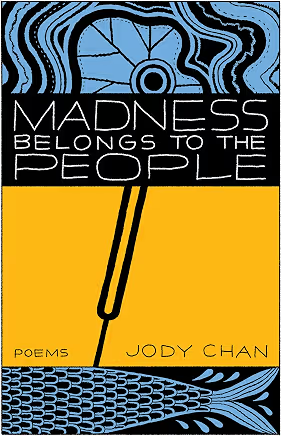
Jody Chan’s poetry collection Madness Belongs to the People is poignant and inventive in its use of language as both weapon against oppression and tool for understanding.
Gabrielle Bates wrote of the book:
“Like Tyehimba Jess’s Olio or Theresa Hak Kyung Cha’s Dictee, Jody Chan’s Madness Belongs to the People enlivens, with its interactive and interdisciplinary elements, the possibilities of what a book of poems can do and be. Taking madness as a series of guiding energies, formal possibilities, and generative constraints, these stirring, participatory poems are wise, layered, and full of gifts to such an extent I find myself finishing the collection eager, immediately, to reread them all. This erudite, passionate work evidences a deeply embodied politicization that understands, in relation to liberatory movements, both the powers and limits of language. Here are words that touch you, singing: ‘may language move you to action.’”
In their own words, here is Jody Chan’s Book Notes music playlist for their poetry collection Madness Belongs to the People:
Madness Belongs to the People exists as a book, as well as an accompanying ambient electronic album composed by the percussionist (and my friend) Yang Chen. What does madness sound like? For us, this question was a literal one, its answers including: organ, wood block, pearl barley, bass drum, bowed cardboard, knifed glass, ripped newsprint, and other unimaginable instrumental combinations, sometimes all at once. For writers like Fred Moten, Stefano Harney, La Marr Jurelle Bruce, and Bedour Alagraa, whose work underpins these poems, the question is also theoretical. Harney and Moten: How do we locate the wild beyond — a space of ungovernable noise, rather than regulatory sound — that already exists through our practices of stealing life back from professionalized institutions? Bruce: “How might music in madtime enhance our playlists for protest and soundtracks for revolution?” Alagraa: How do we “break the metre” of colonialism, slavery, and their legacies in Western liberalism? Not all the music on this playlist is easy listening, let’s say. But all of it is doing beautiful (or even better, weird) things with time and texture and silence.
“endless”, oklou (2025)
A soft entry to this playlist, and the inside of my writing mind. Glitchy scratches and submelodic rumbles. Also kind of a synecdoche: I listened to this whole album *endless* times during my final stages of revision, in addition to oklou’s “choke soundscape” NTS show, a languorous, loopy, low-percussion landscape of her own musical inspirations while writing the album. A nesting doll of sonic influences! I always mishear one of the lyrics, “is the endless still unbound”, as “is the endless still inbound.” Or maybe it’s the other way around. She’s said in interviews that the lyrics aren’t the most important part of the music.
“Freedom Time (Live)”, Ms. Lauryn Hill (2002)
“There’s a war in the mind over territory for the dominion,” Lauryn Hill says, “who will dominate the opinion,” her voice breaking, the guitar straining. “We have to give ourselves over to a certain kind of craziness,” said Halberstam, in his introduction to Harney and Moten’s The Undercommons. “No artist that has widespread appeal is supposed to say this stuff. That’s why they called her crazy,” said @randomfools808 in this song’s YouTube comments. What else is there to say about madness as a tactic to counter cultural hegemony? Nothing! So I wrote a 120-page book about it! Fiery darts thrown by the workers of the arts!
“silt”, Yang Chen (2022)
Yang’s debut album is an archive of Covid lockdown longing. Each track in longing for _ is the result of an idiosyncratic collaborative process. They missed their friends! So they asked the friends to write music for them to play! Some pieces came to Yang fully formed, others as a sparse textual score, requiring their interpretation. “silt”, composed by and performed with Sara Constant, is the track that made me know I wanted to collaborate with Yang too. You can hear some of the same new music improvisational techniques and dissonant textures on the Madness album. Mad, genius. Watch the music video, directed by Serville Poblete and starring Esther Phua and Luisana Reyes, for some dialled-up, hair-splayed-on-the-floor, running-hands-along-the-hallway extra crazy energy.
“Dysfluent Waters”, JJJJJerome Ellis (2021)
Here’s the centrepiece. All of JJJJJerome Ellis’ work, really. Aster of Ceremonies, The Clearing, Vesper Sparrow. I had so many conversations with Yang about the relationship between text and sound, which was meant to subordinate the other, which to serve, how to ensure the sonic density of the album and the textual density of the book didn’t overwhelm each other. And Ellis just does it. Slavery, silence, “is dysfluency a form of perfect memory,” tripping flute, Toni Morrison, Édouard Glissant, “are my glottal blocks floods,” ebullient trumpet, keys and strings melting together, Christina Sharpe. A friend attended one of Ellis’ performances in 2022 and messaged me right after, “it sounded like the inside of my brain and maybe yours too?” Then I got to be at a performance in 2025. For weeks after, I couldn’t stop telling everyone how life-changing, how inspiring it was for me in terms of making my inter-disciplinary disabled art. They also brought a stuffed hippo onstage to ground them — a gift from their wife — which was inspiring for me in terms of getting a wife.
“Nights”, Frank Ocean (2016)
When I put “Nights” on a playlist it has to be right at the halfway point. Or else. It’s not a controversial opinion that this song is basically perfect. At 3:30 in the track, the exact halfway point of the album, Ocean downshifts the beat. From resentfully releasing an ambivalent lover to being displaced by Hurricane Katrina. The grief of losing a relationship subtended by the grief of losing a place. “Nights” reminds me that form can allow us to feel what seems too obvious to say. Subterranean grief changes the time signature. Every ending is a rehearsal, and so is every beginning.
“All Rivers At Once”, Orphx (2016)
Here’s the reversal. Grimy, driving, repetitive, distorted. If this isn’t what the wild beyond sounds like, I don’t know what is. I could dance all night, sober, with tiny flashlights on my fingers! I could sit through four hours of a Marxist-Leninist reading group! I could charge through a line of cops (hypothetical)! The siren under the synth makes me feral.
“when i enter a room, i look to u”, Yaz Lancaster (2025)
A dose of tense, escalatory sweetness to get us through. To me, a track that clocks in under two minutes is like a prose poem: expansive in its concision, the proximity of everything inside it to everything else. For Madness, I stacked (what I would consider) prose poems into (sort of) lyric essays. Does that make the essay like an album? I don’t know, but I love when the violin splits into multiple voices. Haunted, haunting.
“Haenim (햇님)”, Kim Jung Mi (1973)
I wrote one such essay which explored Teresa Teng’s love songs being labeled as “bourgeois spiritual pollution” and banned during the Cultural Revolution. The essay got cut somewhere along the way from the manuscript’s first draft to its final; mostly because I was already approaching 150 pages, to my editor’s chagrin. In hindsight, I’m also glad about the cut because I did a pretty bad job of exploring the political nuances here, including that the anti-communist KMT used Teng’s music as propaganda and psychological warfare against the CCP, and that part of the reason for the CCP’s censorship of Teng was China’s imperialist relation to Taiwan (Teng was Taiwanese). Anyway! Kim’s music, like Teng’s, was censored — but under very different circumstances. Kim was arrested in 1975, under the anti-communist, American-backed dictatorship of Park Chung Hee. Futuristic and affecting, her psychedelic rock record was pulled off shelves and destroyed. Her producer, Shin Joong Hyun, had defied an order from Park’s office to write a song praising the dictatorship.
“Amber Waves”, Ethel Cain (2025)
And here’s the unravelling. The woo-woo-wooshing. I have to include some Ethel Cain. Perverts, specifically, another album I played repeatedly during my revisions. The overlaid static distorts Cain’s typically angelic vocals just enough for me to accept this song’s beauty as part of this world, not transcending it. Madness Belong’s last section includes a love poem, to which I tried to apply this same ethos. I’ve performed that poem at a few readings now. Once, I described it as a “Marxist love poem”, and then an audience member came up to me afterward and told me it wasn’t a very good love poem.
Honourable mention to Perverts’ “Housofpsychoticwomn”, which is just a bit too scary to put on this playlist.
“New World Coming (darkDARK Remix)”, Nina Simone (2020)
I was introduced to this remix by one of the participants in a poetry workshop I facilitated in 2025. The workshop theme was endings and beginnings. An excuse to further my obsession with death, structurally and thematically — for pedagogical purposes! I did have the group do some icebreaker activities, like making a collective workshop playlist. I did not force everyone to participate. I like that this is a remix of a cover (“New World Coming” was originally written by Barry Mann and Cynthia Weil for Cass Elliot) which embodies, most truly and ineffably, the essence of what the song was always meant to be. There were moments I felt it, while doing the organizing I wrote about in Madness: that wild swell, belief’s long arc. In the titular essay from Of Weapons and Words: Al-Aqsa Flood and the Compass of Anti-Colonial Resistance, Amer Mohsen writes, “‘Certainty,’ for me, is when you believe in something, are convinced of it, and commit to it to the extent that you accept the possibility of victory just as you accept the possibility of defeat—because it is the right choice, or the only choice. And that is all the certainty you need.”
Jody Chan is a poet, multidisciplinary artist, care worker, and community organizer. They are the author of two previous books of poetry: sick (Black Lawrence Press 2020), finalist for the Lambda Literary and Pat Lowther Memorial Awards, and winner of the 2018 St. Lawrence Book Award and 2021 Trillium Award for Poetry; and impact statement (Brick Books 2024), longlisted for the Pat Lowther Memorial Award. Jody was the 2023–2024 Artist-in-Residence at the University of Toronto’s Queer and Trans Research Lab, and the 2023 recipient of the Joseph S. Stauffer Prize in Literature from the Canada Council for the Arts. They live in Toronto.