In the Book Notes series, authors create and discuss a music playlist that relates in some way to their recently published book.
Previous contributors include Jesmyn Ward, Lauren Groff, Bret Easton Ellis, Celeste Ng, T.C. Boyle, Dana Spiotta, Hanif Abdurraqib, Andrew Sean Greer, Roxane Gay, and many others.
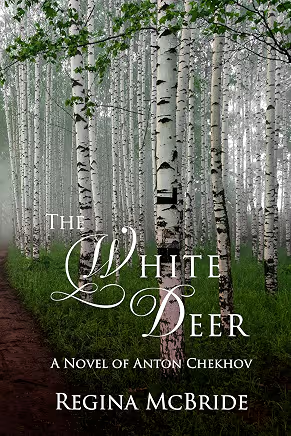
Regina McBride’s novel The White Deer is an imaginative look into the lives of Anton Chekhov and Vera Denisova.
Roxana Robinson wrote of the book:
“Regina McBride’s new book evokes a loving nostalgia for a place we’ve never known—Chekhov’s Russia. Set in the summer of young Anton’s twentieth year, the novel centers on a young woman whose family is losing financial control of their estate—an estate famous for its orchards. Anton is the guest of a neighboring doctor, and the two young people become entwined in a romantic friendship—une amitiée amoureuse. McBride’s story comes at Chekhov’s from the side, presenting us not only with the family’s eccentric and complicated history, but the vision of the author himself, as a character in the work. A beautiful and eloquent rendering of a place and time we somehow feel is ours.”
In her own words, here is Regina McBride’s Book Notes music playlist for her novel The White Deer:
Scheherazade Opus 35, Rimsky-Korsakov
Symphony Orchestra and Chamber Choir of the Conservatory of Music
(opening measures)
A magical, at times emotional and playful symphony based on the stories of One Thousand and One Nights.
Anton, a visitor to the area, a guest of the local doctor, comes upon Vera when she is weeping convulsively. At first, through her tears, she cannot see him clearly in the doorway, but his voice has the same timbre and depth as her departed lover, Petya’s voice, who she is crying over. Anton leaves her to her privacy, but she seeks him out in a few minutes. Right away there is a kind of recognition between them and their first conversation becomes lightly flirtatious and at moments playful. Vera is charmed by this young man who asks to walk her back to Volkhov, the nearby estate belonging to her aristocratic family.
Song of the Indian Guest, Rimsky-Korsakov
Symphonic version (not the operatic)
(go directly to the melody, which comes up pretty quickly)
A hypnotic and unforgettable melody. In the opera, Sadko, a remarkable guest tells a party of people about his homeland.
Anton, the outsider at Volkhov, describes his childhood to a gathering of aristocrats over a meal. He came from a poverty-stricken background, which he does not try to hide. He is polite, maybe at times excessively so. He has a natural sense of decorum and believes that the mark of a refined person is kindness and consideration. Though his father was born a Serf, Anton is engaged and engaging and feels comfortable among aristocrats. And he is, by most, appreciated.
Afternoon of the Faun (Prelude a lApres-Midi d’un Faune), Claude Debussy
Leopold Stokowski with the Leopold Stokowski Symphony Orchestra
(begin at 5:20 and go as long as you can)
Stokowski called this piece “a miracle of delicate, erotic beauty, suggesting a dream world of pagan loveliness”.
A white deer has been spotted on the back acreage at Volkhov. Anton tells Vera that it is great luck to see a white deer because it represents future happiness and offers the opportunity to exchange an old life for a new one. They make it their mission to see the deer and spend many days alone for long hours in each other’s company, wandering the meadows and forests. Under these idyllic conditions a romantic friendship evolves. When, surreptitiously through Anton, Vera learns that the trees of her beloved childhood estate are destined to fall under the axe, their long hours spent together in nature become bittersweet and take on a certain urgency. They fantasize about stopping time.
In the Grove by the Danube (Ukrainian Folk Song)
Oh, in the grove by the Danube
A Nightingale chatters
To all the birds of his flock
To his nest, he’s calling…
Vera’s mother, Pelegaya, loves to sing old Ukrainian folksongs, though she does not always stay in tune. Still, Vera loves to listen to her mother sing, especially this song, which was her favorite when she was small.
Vera’s mother and older sister, Sasha, share a secret that Vera is left out of. Vera only knows that it is something terrible and related to the time her mother spent in Siberia where her older sister was born. Siberia hangs over everything in this story as a place of terror and loss. The Ukrainian folk songs are from her mother’s childhood before Siberia destroyed her family and her mind.
Marriage Song (Russian folk song)
Russian State Symphony Cappella
It is performed in Russian but here are the lyrics translated to English.
Here, everything has passed,
I am already under the wedding crown.
They have bound the young man
With a golden ring.
Only, it is not with you,
My dear one.
You are sleeping beneath the earth,
Sleeping because of me.
The song is written from the perspective of a man who is standing at the altar marrying someone else, while the woman he truly loved has tragically died (and he blames himself for her death).
Vera’s father pines for his wife (Vera’s mother), whose room he has been banished from for over a decade, and sings phrases of this song abstractedly as he walks along. These lyrics are often on his mind.
Nocturne 1, Clouds, Claude Debussy
Leopold Stokowski with the London Symphony Orchestra
(begin at 1:20)
Debussy said that this particular piece was meant to offer the impression of “the immutable aspects of the sky, the slow, solemn motion of the clouds fading away in gray tones lightly tinged with white”.
As Vera and Anton spend comfortable hours in each other’s company, wandering the forests and meadows of Volkhov looking for the white deer, they often enjoy introspection and silences that forge their closeness and lead to sharing confidences. This music suggests that slow drifting of thoughts.
Scheherazade Opus 35, Rimsky-Korsakov
Symphony Orchestra and Chamber Choir of the Conservatory of Music
(0boe at 11:53)
Vera is still often overcome with longing for the missing Petya, but she finds that Anton has begun to eclipse him. Vera tells Anton that he looks a lot like Petya, that he is just a little taller and his hair is darker, that Petya has blue eyes and Anton has brown. She tells him that the two are very different in personality but physically they are alike. “You both have the same heavy eyelids. Even when you are wide awake you look a little sleepy.” This observation seems to give Anton pleasure, and he loves the idea that Vera’s beloved Petya may be his doppleganger.
Vera has a drawing that Petya had done of her half naked. She imagines handing it to Anton and watching as he unrolls it. She imagines his silence as he looks at it, his eyes flashing to meet hers. “The drawing had left its gray silvery dust on my fingertips. And if Anton held it, if he unrolled it and touched it, it would leave the same gray, silvery dust on his.”
Bayu Bayushki Bayu
Anton sings this old traditional lullaby to Vera’s belly when she believes she’s pregnant.
Bayu-bayushki-bayu is a traditional Russian lullaby that warns a child not to sleep on the edge of the bed so a grey wolf will not grab them. Many traditional lullabies used scary elements to make sure children stayed safe and still in bed. It is an interesting combination of comforting and frightening.
from Six Consulations, Franz Liszt
Beatrice Berrut
(begin at 1:29)
Vera comes across her mother’s friend, Maxima Gabinskaya, a woman who dresses with a masculine flair and at one time played piano with the Petersburg Philharmonia, playing this piece in the empty downstairs ballroom. Vera appeals to her mother’s friend to reveal the secret at the heart of her mother and sister’s lives.
Tchaikovsky’s 5th Symphony, Second movement
Russian Philharmonic
After the summer spent together, Vera and Anton correspond as their lives undergo profound changes.
It was Anton’s staunch belief in Vera’s gift as an actress that encouraged her to pursue a life in the theatre.
When Vera learns of Anton’s death from tuberculosis at forty four, she rereads all the letters he sent her since that idyllic summer. As she grieves the loss of Anton, she sees how the intimacy they shared continued throughout his life to have meaning for him. He based his final play, his masterpiece, The Cherry Orchard, on the summer he spent with Vera at Volkhov.
also at Largehearted Boy:
Regina McBride’s playlist for her novel Stranger From Across the Sea
Regina McBride is the author of eight books. The White Deer: A Novel of Anton Chekhov is her sixth novel. She is also the author of one memoir, Ghost Songs, and one book of poetry. Her novel The Nature of Water and Air was a Booksense Pick (Independent Book Stores Selection), a Barnes and Noble Discover Great New Writers book, and a Borders Original Voices choice. It was optioned for a film. A recipient of fellowships from the NEA and the New York Foundation for the Arts, she lives in New York City, where she taught fiction writing for thirty years at Hunter College and continues to teach privately.