In the Book Notes series, authors create and discuss a music playlist that relates in some way to their recently published book.
Previous contributors include Jesmyn Ward, Lauren Groff, Bret Easton Ellis, Celeste Ng, T.C. Boyle, Dana Spiotta, Hanif Abdurraqib, Andrew Sean Greer, Roxane Gay, and many others.
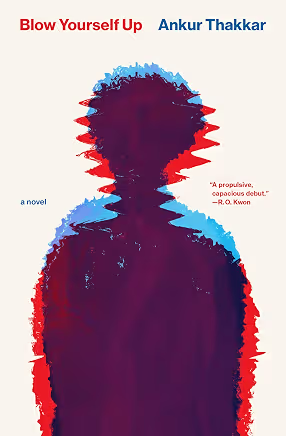
Ankur Thakkar’s novel Blow Yourself Up is a provocative and compelling debut.
The Chicago Review of Books wrote of the book:
“Blow Yourself Up is a love story for our modern times, exploring the ways in which the internet dazzles and destroys us with humor and humanity”
In his own words, here is Ankur Thakkar’s Book Notes music playlist for his debut novel Blow Yourself Up:
Blow Yourself Up features a young music prodigy, Arjun, who can pick up almost any instrument with ease and uses his talent to win the heart of his first love, Payal. A gift like that can seduce you into thinking it’s what you’re supposed to do with your life, and Arjun goes on to play in bands and try to make it as an artist as Payal becomes a popular creator on a looping video app. Music is core to this novel, and although I mostly listen to ambient music while writing, these are the songs that make up its DNA, freckled with nostalgia but facing the future.
American Football – “Never Meant”
We must begin with Midwest emo. I worked at Vine for a few years and the last one I made, shortly before the platform died, featured a seamless audio loop of this song’s perfect guitar riff. It was my first attempt to say goodbye to a community I loved. My second attempt was Blow Yourself Up. One strategy at closure is to pretend it was never meant to be, because if you pretend for long enough, maybe it will become true.
Lorde – “400 Lux”
The novel begins and ends in a car, with two characters in close proximity, communicating without really speaking but maybe through music or a touch. Having grown up in a suburb, so many of my core memories growing up were on drives like this, whether there was a clear destination or not, because it was just important to learn how to waste time together.
Bloc Party – “Blue Light”
Another post-breakup banger that, like many Bloc Party songs, is structured like an effective novel. You have the narrator finding memories in small spaces, the quiet realization that everything has changed, the drums picking up as the stakes get bigger and the narrator goes further and further inward to a climactic release that feels like the space love fills when it’s no longer there.
Diljit Dosanjh – “Morni”
There’s this moment that happens at too many parties where the DJ puts on “Mundian to Bach Ke” aka “Beware of the Boys” ft. Jay Z, the ubiquitous Punjabi track, and everyone’s attention turns to the nearest brown person with expectant eyes, expecting us to do that shoulder dance. There are so many other Punjabi songs! I’m grateful for the recent explosion of artists like Raf-Saperra and Sidhu Moose Wala may he rest in peace. At the current helm is Diljit, the first Punjabi artist to sell out Madison Square Garden and creator of a viral dance when we performed this song on The Tonight Show earlier this year. Bhangra and Punjabi music play a strong role in Blow Yourself Up’s plot, and it was incredible to see the real world mirror its rise. Punjabi aa gaye oye.
Metric – “Calculation Theme”
One of the ideas I wanted to engage with was the impressions we leave online that have lives of their own, like we’re creating our own ghosts. It’s that feeling of stumbling upon a platform you stopped posting to a decade ago, and scrolling through who you used to be, even though it’s all in present tense. Or how reading through a dormant conversation with an ex can still feel so alive. This song’s outro introduces two ghosts continuing a conversation between lovers no longer in touch, asking: “who put these bodies between us?”
Kanye West – “All Day”
Yes, but hear me out. Of course this novel was influenced by Chicago’s patron saint. There’s a defiance in Payal and Arjun that, for better or worse, affects who they become. Internet culture invented the troll, something both of them grapple with, and this song is the epitome of a troll, a manifesto, and a meme all at once. It goes so much harder than it needs to.
Djo – “End of Beginning”
And speaking of Chicago, what an amazing place to make art. Joe Keery attended DePaul and made music before getting famous, and there is something about being in Chicago in your twenties that makes it impossible to not get wistful about. This city gives you so many opportunities to interact with other artists without hierarchy. Chicago is obviously not without its deep systemic issues, and it was important to me to try and capture what makes it so special in this novel.
This was the first release from brown boyband supergroup Himanshu ‘Heems’ Suri and Riz Ahmed. The pair strike a perfect transatlantic tension between their raps and I hope they make another album soon. Riz recently brought Heems on in an episode of his incredible show Bait, so I think it’ll happen. I was fortunate enough to begin Blow Yourself Up with an epigraph from Heems, which is perfect because every time I sit down to write I whisper the first line of his verse and lock the fuck in.
The Strokes – “What Ever Happened?”
I moved from Chicago to Williamsburg long after the post-9/11 rock scene dissipated, but a walk through town could lead you to The Levee, formerly Kokies, which was dubbed “Cokies” by the East Village kids that would walk across the bridge to partake. Down the street is The Four Horseman, the award-winning wine bar by James Murphy of LCD Soundsystem. The aughts also brought the tech platforms to the neighborhood and, along with it, the high rises, the Kickstarter headquarters which is now a hype house for TikTok creators, and the Sephora/Whole Foods/WeWork/Slop Bowl Industrial Corridor. It’s not ever clear what’s happening in the moment, but the wisdom of years is important to this novel, to ask “who’s culture is this and does anybody know?”
Radiohead – “Everything in its Right Place”
There is a scene where Arjun is describing to Payal how music feels in his mind, like patterns that map to emotions and memories. I haven’t listened to this song, or to Kid A, in years because I know how much it will affect me, as if by not listening to it I can preserve its power for when I need it most. Actually, the last time I listened to Kid A in its entirety was exactly twenty years ago. I was sitting in the empty McCarren Park Pool waiting for The Shins to come on stage and the DJ decided to just play Kid A in full. I don’t know why but it remains, to this day, the most profound concert experience I’ve ever had, and the band wasn’t even there. When you work on a novel for more than a decade, speculative elements can become embodied, or like an alternate history of what the future almost was, could still be, which is exactly how this song feels.
Ankur Thakkar is a multimedia artist and the author of the novel Blow Yourself Up. He was a Tennessee Williams Scholar at the Sewanee Writers’ Conference in 2025 and his writing has appeared in Guernica, PANK, and TriQuarterly. Medium selected his piece, “Swipe,” as one of the best personal essays about the internet. His artwork has been shown at the Palais de Tokyo and La Friche la Belle de Mai. He chose MFA, then NYC, and lives in Brooklyn.