In the Book Notes series, authors create and discuss a music playlist that relates in some way to their recently published book.
Previous contributors include Jesmyn Ward, Lauren Groff, Bret Easton Ellis, Celeste Ng, T.C. Boyle, Dana Spiotta, Hanif Abdurraqib, Andrew Sean Greer, Roxane Gay, and many others.
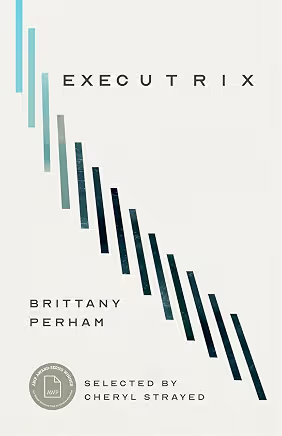
Brittany Perham’s Executrix is a memoir both inventive in form and poignant.
Booklist wrote of the book:
“Playing with the official language of audits and lawsuits, Perham is in the rare camp of writers who can dance between pathos and humor without diminishing the seriousness of her subjects. This is a striking memoir of what surfaces when dealing with the vestiges, physical and emotional, of a deceased parent and all the stories we have made them, and us, out to be. ‘I have to tell you not much changes between the beginning and the end. I don’t know and then I don’t know,’ Perham writes. But it may be impossible to read this book without being changed by it.”
In her own words, here is Brittany Perham’s Book Notes music playlist for her memoir Executrix:
Executrix is a family story. It’s about alcoholism, estrangement, stolen money, death, and the nasty business of sorting out an estate—all the cheeriest things. And also, childhood. Many of the sections take place in hospitals, especially in Mass General Hospital, where my brother was sick as a kid and where my father died, after we’d gone more than a decade without really speaking, due to alcoholic cirrhosis. There are also funeral homes and bars and lawyers’ offices. But the book has lightness, too, because darkness and misery can be funny if you look for it, and because childhood is strange and magical and incomprehensible. In the list below, I’ve tried to think of songs (cheesy and schmaltzy) that bring back good memories of my family from the ’80s, ’90s, and early 2000s. Most of these don’t exist in the book. Writing down my memories and telling them to you will turn them into stories, which I know will influence the memories themselves in ways I can’t yet predict. Executrix explores this process of memory creation, asking questions about why we make narratives out of our experiences and how those narratives go on to inform our lives.
You Are My Sunshine – Jimmie Davis & Charles Mitchell
My mother used to sing me this song when I was a little kid, when she was putting me down for a nap or trying to get me to go to sleep at night. She has a memory she’s told me many times of the song coming on the car radio—she drove a Volkswagon Rabbit that would often overheat on the way to school—and I said, from my car seat, “Mom, they know your song!” This feels like my memory too, although I don’t think it is—it’s my mother’s that, through her story, has been transferred to me. Now it lives in my brain as memory, solid as other “memories” I have of my early childhood, and to it, I’ve added my impression of the car frequently breaking down (which my mother said happened only once or twice, and when I was older) and of the road we drove to school every day. This example of my mother’s memory getting mixed up with mine got me thinking, as an adult, about how we make memory and meaning, and about how our memories actually come from a broad range of sources, many of them exterior to us. That’s one of the big stories of Executrix.
Kokomo – The Beach Boys
My father would play—and (horrifyingly, if my friends were around) sing along to—this late, not-so-great Beach Boys song on summer afternoons while he was working in the yard or grilling hotdogs—in other words, when he was happy and home. And not drinking, or at least not drinking and crying. I have memories of him jumping into the pool with his sunglasses still on. I still like hearing this song because it brings back this particular vision, an uncomplicated joyful memory I have of my father.
Can’t Help Falling in Love – Elvis Presley
My brother went through a phase, age 5 or 6, where he sang this song endlessly, imitating Elvis’s voice and dancing, moussing his hair back with my mom’s aloe vera gel (she wasn’t the kind of mom who had hair products) to get the full look. He’d just had his ear pierced, and he wanted a leather jacket. There were other phases when he was into Will Smith and Bing Crosby, but I’ll always hear my brother singing Elvis, jumping around on the couch with his hair slicked back and his sunglasses on, television remote as microphone, and that will always be a sound of childhood.
Home Again – Carole King
I listened to this song hundreds of times in my childhood bedroom when I was sixteen and seventeen, thinking about how unfair it was that I had to grow up and leave home. During these years, my mom was adamant that I would go to college and I was adamant that I would not, that I would live in my childhood bedroom forever, singing Carole King as loud as humanly possible, and that nothing would change. I understood already, before I’d ever had to leave anyone or anything, that once you leave, you can’t go back. And in fact, I did go to college, and in the next years my parents divorced and my brother got sick and my childhood home got sold. But it turns out I did go back, at least as far as I could, in Executrix.
I Can See Clearly Now – Jimmy Cliff
I remember hearing this song on an airplane on the way back from Florida with my family, one of the last vacations we took together. When I think about it now, I don’t know how this memory could be true: Did I have it on a mix tape in my Walkman? Was it somehow playing in the cabin? Was I only signing it in my mind? All these things seem improbable because in my memory, this is the first time I’ve ever heard this song. The plane is rising over the clouds, fairytale, vision-of-heaven, Care Bear cartoon clouds, the sun is hitting me in the face, and here is the rainbow I’ve been waiting for, my father’s laughing and my family is together.
Perfect Blue Buildings – Counting Crows
When my brother was 14, and my parents were mid-divorce, he got really sick and was admitted to the PICU of Mass General Hospital. At some point, someone handed me his belongings. One of the things he had with him, which he’d taken to school that morning, was a Discman with August and Everything After inside. My mother and I took turns sleeping (or not sleeping) in a tiny room with a cot that they give family members of very sick children. I listened to this album, and this song, many times in that room, on my brother’s headphones, through the first scary week of him almost dying, and then hundreds of times over the next months, when he was in and out of the hospital. I didn’t listen to any other music that year. I drove with my car radio off. If I heard a song come on in a room, I left the room. It was a kind of superstition, a charm to make sure he wouldn’t die. And he didn’t die.
Walking to You – Everything But The Girl
This song was on a mix CD my then-girlfriend burned for me when my brother was just out of the hospital and I was going home from college to babysit him on weekends while my mother was away, having met someone new after separating from my father. This girlfriend also taught me to make scrambled eggs with sour cream, which seemed very grown-up. She cooked them for my brother and me in my childhood kitchen the mornings she was there, and then, on the mornings she wasn’t there, I cooked them for my brother and me, and we were a family of two. That CD, and that song in particular, brought me so much joy—the kind of singing-loud joy you need when nothing much feels like joy—that soon she burned me the entire Amplified Heart album and that got me through the rest of 2002.
The Animal Song – Savage Garden
My partner says if I include this song, even with the memory attached, everyone will know how bad my music taste really is. But here it is: The first present my brother ever bought me with his own money was tickets to a Savage Garden concert at the FleetBoston Pavillion. I have no memory of the concert, but I have a windblown, sweaty-summer vision of my college roommate driving my brother and me through downtown Boston, windows open, blissfully blasting The Animal Song as loud as her stereo would go, all of us screaming along, performing wildly for the eyerolls we got from the drivers next to us at every red light.
Someday Soon – Judy Collins
A song about doomed young love (because what other kind is there?) that is also about fathers and daughters, specifically a father giving a daughter advice she isn’t going to take. Here are a few lines:
My parents cannot stand him
‘Cause he rides the rodeo
My father says that he will leave me crying…
And when he comes to call
My pa’ ain’t got a good word to say
Guess it’s ’cause he’s just as wild in the younger days
By the end of the song, the speaker (and we) get that this love, with a guy who “loves him damned old rodeo as much as he loves” her, will never work out. But there’s another revelation too: The speaker realizes something about who her father is. She understands why he feels and acts the way he does, something we sense the father doesn’t fully understand about himself. One of the reasons I wrote Executrix was to learn more about my father because we’d been estranged for more than a decade when he died and I didn’t know him very well. Anyone who’s experienced this knows that relationships continue when we’re estranged, and after someone dies, too. Executrix is a conversation I’d like to have had with my father but never could.
You Gotta Be – Des’ree
Listen as your day unfolds
Challenge what the future holds
Try and keep your head up to the sky…
Herald what your mother said
Read the books your father read
Try to solve the puzzles in your own sweet time…
You gotta be bad, you gotta be bold, you gotta be wiser
You gotta be hard, you gotta be tough, you gotta be stronger
You gotta be cool, you gotta be calm, you gotta stay together
My get-me-through-the-shit theme song of the ’90s, back when you had to wait for your favorite song to come on the car radio, this one requires no explanation. Sing it if you need it.
Brittany Perham is the author of Double Portrait (W.W. Norton), which won the Barnard Women Poets Prize and was a finalist for the Northern California Book Award; The Curiosities (Free Verse Editions); and, with Kim Addonizio, the collaborative word/art project The Night Could Go in Either Direction (SHP). Her writing has received support from the Civitella Ranieri Foundation, the Hemingway House, the James Merrill House Foundation, Vermont Studio Center, the Wallace Stegner Fellowship Program, and Yaddo. New work in poetry and prose may be found or is forthcoming in The Cortland Review, Gulf Coast, Poetry, Prairie Schooner and Tupelo Quarterly. Her memoir, Executrix, won the AWP Sue William Silverman Prize for Creative Nonfiction and will be published by the University of Georgia Press in 2026. For more information, please visit: https://www.brittanyperham.com/.