In the Book Notes series, authors create and discuss a music playlist that relates in some way to their recently published book.
Previous contributors include Jesmyn Ward, Lauren Groff, Bret Easton Ellis, Celeste Ng, T.C. Boyle, Dana Spiotta, Hanif Abdurraqib, Andrew Sean Greer, Roxane Gay, and many others.
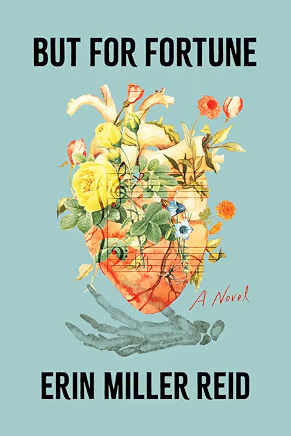
Erin Miller Reid’s novel But for Fortune brings two generations of Appalachian women and their struggles to life in this profound debut.
Kirkus wrote of the book:
“An earnest, affecting novel about the painful consequences of the lack of effective mental health care.”
In her own words, here is Erin Miller Reid’s Book Notes music playlist for her debut novel But for Fortune:
But For Fortune is an exploration of both family legacy and family secrets. It follows two Appalachian women fifty years apart, a grandmother and her granddaughter, as they each struggle with their unique experiences of mental illness and discrimination. I finished my novel in August 2022. It wasn’t the version that exists today, but it was the draft I felt ready to send into the world to agents and editors. The weekend I finished it, I launched into creating a playlist for the book, a task that took an entire day. I spent hours moving through the book, chapter by chapter, setting scenes and themes to music. It was cathartic. I obviously needed to continue to create with these characters. I wasn’t quite ready to put them on the shelf. My original playlist is thirty-nine songs long and lasts over two-and-a-half hours. It includes songs referenced directly in the novel, songs chosen for the mood of a moment, songs that give voice to my characters’ motivations and emotions, and a few songs that reflect my own experience in writing the book. It wasn’t an easy task to cull thirty-nine songs to ten, but like any good editing session, a writer must make tough choices. The revised playlist succinctly reflects the heart of my novel—two women overcoming angst and striving toward hope with a heavy helping of family drama.
1. Joan Baez – “There But For Fortune”
I was raised on 1960s folk music. It was my dad’s favorite, the music of his youth. On our drives to church and school and on family road trips, we were serenaded by Judy Collins, The Kingston Trio, Peter Seeger, Arlo Guthrie, and Peter, Paul, and Mary. I was raised on their words, lyrics that cried out for social justice. Perhaps the song that shaped my early self the most, the song I remember best from the cassettes playing on the dashboard tape deck of a 1986 Buick Century, was Joan Baez’s cover of Phillip Ochs’s “There But For Fortune,” the inspiration for my novel’s name. From Baez’s clear, ethereal vocals, I learned an attitude of empathy, an awareness that the life can take a harsh turn at any moment, that often luck is the only buffer of misfortune.
2. Brandi Carlile – “The Story”
I was struck the moment I first heard “The Story” as background music in a car commercial for the 2008 Summer Olympics. A day later, I picked up my friend from the airport and immediately played it for her in the car. “You have to hear this song.” I rolled down the windows of my car as one does before cranking up the volume to full blast, and she laughed at my exuberant enthusiasm. Since then, “The Story” has become one of my favorite songs. In fact, my youngest daughter and I call it “our song,” and listen to it on repeat as I drive her to ballet. The song starts softly, then builds with powerful emotion. I get chills when Brandi’s voice breaks on the higher notes. I feel the urgency in her voice. No matter how many times I listen to it, this song gets me every time. I chose it for my novel’s playlist based on one verse: You see the smile that’s on my mouth, It’s hiding the words that don’t come out, And all of our friends who think that I’m blessed, They don’t know my head is a mess. My novel is about mental health and how it can strike anyone, no matter their measure of success or seemingly charmed life. However, I took a whole novel to tell what “The Story” does in a single, powerful four-line verse.
3. Elliott Smith – “Miss Misery”
As an easily distractible person, I don’t normally listen to music while I write. However, the day I wrote the chapter of protagonist Corinth’s mental breakdown, we had workers in our home renovating the basement. The incessant hammering, drilling, and jovial work banter proved an even bigger distraction than music. I put in a pair of earbuds and listened to “Miss Misery” on repeat to block out the noise. Elliott Smith sings hauntingly of his own depression and struggle with alcoholism. Will you miss me when I’m gone? he asks his anthropomorphized sorrow, Miss Misery. The song set the mood of angst as I wrote, and enabled me to reflect Corinth’s anguish on the page.
4. The Local Honeys – “Walk Around My Bedside”
If “Miss Misery” inspired Corinth’s mental suffering, “Walk Around My Bedside,” a traditional gospel hymn, reflected her grandmother Mary Esther’s turmoil. In melancholic melody, the lyrics beg for Jesus to be near. The fiddle tones are desperate pleas. Linda Jean Stokely and Montana Hobbs sing with tightly harmonized vocals that are both poignant and eerie. I imagine Mary Esther, in her darkest moments, praying for any relief from her mental demons in a taut harmony of faith and fear.
5. The Local Honeys – “Toadstool”
Full disclosure: when I imagine my novel as a movie (don’t all authors have this fantasy?), The Local Honeys form the backbone of the soundtrack. They’re one of my favorites, the perfect blend of old time, gospel, and bluegrass, singing about modern Appalachian themes like poverty, addiction, and the empowerment of rural women. In “Toadstool,” the narrator goes to the forest to repair what is broken. It’s a hopeful song about the healing power of nature. The lyrics paint comforting images of the Appalachian mountains—green mossy bedspread, swift mourning dove, magic moon phase, trees bend to greet me—imagery that makes me thankful I get to live in this beautiful place.
6. Jean Ritchie – “Shady Grove”
In honor of the novel’s eastern Kentucky roots, I want to share at least one song from Jean Ritchie. Her name must always be included when the subject of Appalachian heritage arises. Born in Perry County, Kentucky in the 1920s, Ritchie spent her life and career as a curator, scholar, and performer of mountain folk music, and was integral in passing the tradition to future generations. My kids and I have all taken lessons in old time and bluegrass music. In our family, we have a mandolin player, two fiddle players, and a guitar player, all at varying levels of ability (and commitment). The one song we all enjoy and can play is “Shady Grove,” a sweet but sorrowful song that laments leaving a lover behind.
7. Patty Loveless – “Sounds of Loneliness”
There are only a handful of albums that I listen to from start to finish. Patty Loveless’s Mountain Soul is one them. Each song bridges the mountain music of the past to the present. Patti Loveless sings in a voice that manages to be bright and soulful all at once. I chose “Sounds of Loneliness” to reflect the struggles my characters have with mental health disease. Suffering from depression, anxiety, or any number of psychiatric illnesses is a lonely, insular experience. It’s hard, if not impossible, to reach out beyond the narrow world of self to seek help. Even though “Sounds of Loneliness” reflects the heartbreak of losing a lover, I can imagine so many of the lyrics echo the pain Mary Esther and Corinth feel in the pages of the novel—Hear the sounds of my tears, Fallin down, fallin down, Like the rain comin’ down, Oh the sound, that lonely sound.
8. Nirvana – “Where Did You Sleep Last Night”
I first bought Nirvana’s MTV Unplugged Live in New York CD in high school in one of those Columbia House deals: 8 CDs for a penny! I listened to it at seven in the morning as I got ready for school, sitting on the floor in front of a full-length mirror, a pile of Cover Girl spread on the carpet in front of me, starting my day with Kurt Cobain’s raspy, angst-ridden voice, a voice perfectly suited to the Appalachian murder ballad, “Where Did You Sleep Last Night.” I chose this song for the playlist as a nod to traditional Appalachian music, but also because it makes an appearance in my novel. Mary Esther is angered when her mother-in-law sings a song about treachery and murder to her newborn son. “Where Did You Sleep Last Night,” also called “In the Pines,” has been covered by greats like Bill Monroe, Lead Belly, Dolly Parton, Pete Seeger, and Loretta Lynn. I chose Nirvana’s version because it bridges the timelines of my novel, grandmother Mary Esther’s 1950s to medical student Corinth’s early 2000s, when she watches a band cover Nirvana at bar on Halloween night.
9. The Cranberries – “Ode to Family”
But For Fortune is largely a book about family and the legacy we inherit from our loved ones. I’ve been a big fan of The Cranberries since I was a teenager. I admire the way Dolores O’Riordan so tenderly sings of her parents and childhood in this song. Both protagonists, Mary Esther and Corinth, despite their troubles and challenges, despite imperfect upbringings and early life experiences, find peace in the memory of the love they received as children.
10. Ludwig van Beethoven – “Für Elise”
When I was a kid, my mom had a jewelry box that mesmerized me. The wooden lid had an inlay mirror with flowers etched into the glass. Inside was a music box. When it was wound, a plastic, opalescent white butterfly with a magnet on its belly spun and twirled around the mirror in an unnatural, stiff dance. The song I remember the music box playing was Beethoven’s “Für Elise.” I first considered writing But For Fortunenearly twenty years ago with two formative ideas—my relationship with my real-life grandmother who’d spent decades in a psychiatric hospital and the memory of me as girl watching the white, plastic butterfly dance atop my mom’s jewelry box to the tinny chime of Beethoven.
11. Béla Fleck & Abigail Washburn – “If I Could Talk To A Younger Me“
I was lucky enough to be born into a family that reads. Books were in every room of our home. We spent the summer exchanging weekly piles of books at the library. My dad recommended classics to me and quoted poetry from his favorite poet, Robert Service. From the time I could first read, my dream was to write my own book. Now, forty years later, my dream is being realized. In this moment of fruition, I can’t help but remember myself as a child enchanted by Jo March, Anne Shirley, and Francie Nolan. I want to give the little girl I once was a hug and say, “We did it!” I want to tell her, as Abigail Washburn sings, Follow your heart like a bird set free/Dreams can’t be bought or sold. I’d like Béla Fleck’s cheerful banjo to play in the background of our celebration. And just as these lyrics would speak to my younger self, I envision them also reaching the ears of my characters, Corinth and a young Mary Esther. When Abigail Washburn sings that the darkest hour dies at the dawn, I hope they will take heart and find reprieve, resolve, and above all, hope.
Erin Miller Reid is a writer and physician from southeastern Kentucky. Her work has appeared in North Carolina Literary Review, Still, Appalachian Review, Women Speak:Women of Appalachia Project, Pine Mountain Sand & Gravel, 100 Days in Appalachia, and the anthology Troublesome Rising: A Thousand-Year Flood in Eastern Kentucky. She earned her master of public health and doctor of medicine degrees at the University of Kentucky and completed education in narrative medicine at Columbia University.